Dependence on God: Fueling Effective Prayer

Continuing with the modern rephrasing of “The Christian in Complete Armor” by William Gurnell, with some additions from me.


Paul encourages the Ephesians in holy resolution and courage in their spiritual warfare. However, he tempers this encouragement with a sober warning against relying on their own strength for the fight. He reminds us all to look to the Lord for that- “be strong in the Lord and in the strength of His might” (emphasis added). Our strength lies in the Lord, not in ourselves. This is quite opposite to the way that the world works. The strength of the general lies in his troops. Once the soldiers are lost, there is no way for the general to win the battle. But in the army of the saints, the strength of every single saint lies in the Lord of hosts- Jesus Christ, Emmanuel. God does not need our efforts to overcome His enemies. God does not need us to give Him strength. One of God’s names is “the strength of Israel”, after all. He taught David’s fingers to fight. He strengthened David’s heart as he stood up to Goliath. In the same way, our Lord is the strength of all of his saints in this war against sin and Satan. 


Some propose a question: Is there any sin committed in this world in which Satan has no part? Likewise, one could also ask, is there any righteous action performed without God having a part? And at least that second question is clearly answered in the Bible, “without Me, you can do nothing” (John 15:5). “It is God that works in you to will and to do his good pleasure” (Phil 2:13). “Not that we are sufficient of ourselves to think anything of ourselves but our sufficiency comes from God” (2 Cor 3:5). Without God’s help, even our best efforts are useless.  God’s grace upon grace to us is given on a daily basis, but not activated by our own will or desire; His grace in our lives is activated by God’s own Holy Spirit.  “But God is so rich in mercy, and he loved us so much, that even though we were dead because of our sins, he gave us life when he raised Christ from the dead. (It is only by God’s grace that you have been saved!) For he raised us from the dead along with Christ and seated us with him in the heavenly realms because we are united with Christ Jesus. So God can point to us in all future ages as examples of the incredible wealth of his grace and kindness toward us, as shown in all he has done for us who are united with Christ Jesus. God saved you by his grace when you believed. And you can’t take credit for this; it is a gift from God. Salvation is not a reward for the good things we have done, so none of us can boast about it. For we are God’s masterpiece. He has created us anew in Christ Jesus, so we can do the good things he planned for us long ago” (Ephesians 2:4-10). We have not created our own strength to do good works for God. We have only ever received that strength from the Lord. Consistent, small steps of faith over a lifetime of walking with the Lord requires our dependence on His renewing strength every moment from heaven. 

Even when we are most filled with God’s grace, we can’t sustain it on our own. We need His continuous help to keep going. That’s why Jesus, before leaving for heaven, asked God to watch over His followers. He knew they were like weak children who needed His constant help to stay on track and avoid falling into temptation.

When a Christian sets out to do something for God, like pray, their strength still comes from God. If they want to pray, we may not even know what to pray for as we ought to. If left to our own devices, we could end up praying for things that aren’t good for us. Our hearts are deceptive and desperately wicked, and our vision is limited. We never see the full picture. That’s why God gives us the words to say, like in Hosea 14:2. But even with the right words, if our hearts aren’t in it, those words will feel empty. The fire to make those prayers meaningful doesn’t come from within—that zeal comes from God. The Holy Spirit stirs up our hearts and helps us pray from a deeper place, interceding for us with wordless groans when we don’t know what to say. Without that help, we can’t pray in the way that really connects with God.

We cannot “pray” ourselves better and stronger. Instead, God gives us strength through our prayers. David recounts this happening for him, “As soon as I pray, you answer me; you encourage me by giving me strength”. God’s power is what makes our prayers effective. When it comes to hearing God’s word, our ability to understand it and let it sanctify us also comes from God. He opens our hearts and minds to truly receive what He’s saying. It’s like Samson’s riddle—one that we can’t figure out without the right help. God opens up the heart, just like He opens the mind, so that the soul, once barren, can become full and fruitful. David spent months listening to teachings without truly understanding them, but then Nathan came with God’s message, and suddenly David’s heart was ready. He immediately felt deep sorrow for his sins, and it all poured out in Psalm 51. What made this moment different from all the others? It was God’s Spirit working in him through the word.

God is the one who teaches us to truly understand, as it says in Isaiah 48:17. He’s the teacher, and when the Holy Spirit speaks directly to our hearts, everything clicks. Our understanding opens up, and we feel a fire inside as the truth comes alive. This is how the Christian’s strength comes from the Lord—it’s His power working in us, not just our own effort. Let’s take a closer look at this with some examples.



Strengthening Christian Faith Through Trials

We continue with the modern rephrasing (with some input from me, too) of William Gurnell’s “The Christian in Complete Armor”.


Now we find out how we can have a nation where the majority of people identify as Christian but there are so few people who have a relationship with Christ. So many go into battle against Satan, but so few come out conquerors. All people have a desire to be happy, but few have the courage and resolution to grapple with the difficulties that obstruct their path. All Israel came joyfully out of Egypt under Moses’s leadership. But when the hungry pains struck… when they found out that they had to go to battle with the Caananites to free their promised land “flowing with milk and honey”, they were ready to bail out and give up. This is how the greatest part of people who, when push comes to shove, will deny or grow weary of Christ. Hardship and suffering stand all along the way on our journey to heaven. And there are many who will not have the heart to venture forward through it. They will not have the perseverance to take hold of the joy that is set before them. They may hate the idea of losing heaven, but they hate more to pay such a dear price for it. The young rich ruler heard the cost of gaining eternal life, he turned away sorrowfully. The parable of the sower, throwing out seed to grow, shared that “some fell on rocky places, where it did not have much soil. It sprang up quickly, because the soil was shallow. But when the sun came up, the plants were scorched, and they withered because they had no root. Other seed fell among thorns, which grew up and choked the plants”. Hardship is thethorn that can grow up and choke out growth. Suffering can be that sun that rises and scorches the plants that don’t have a chance to build deeper roots. We require the Holy Spirit empowering this difficult walk to faithfully follow Christ. This holy resolution, this empowerment from God is the only thing that allows you to be faithful to what you profess. Heaven is not for the cowardly of heart, it is for the valiant, the brave, the bold!  God grows a heroic spirit within his children. That is how we can “glory in our sufferings, because we know that suffering produces perseverance; perseverance, character; and character, hope. And hope does not put us to shame, because God’s love has been poured out into our hearts through the Holy Spirit, who has been given to us”.

Jesus tests His followers by their courage. He calls us to pick up our crosses and follow Him, even if it means facing death and danger. It’s unfitting for Christians to shrink back in fear while sinners are bold in their wickedness. Stand firm and don’t hide your faith, even when the world mocks you or pressures you to give up.  

Take heart, Christians—your cause is worth it. God Himself is on your side, and Jesus, the Captain of our salvation, leads the charge. He lived, died, and rose again for you, and He’s with you every step of the way. No leader is as compassionate or as powerful as Jesus, who heals your wounds with His own sacrifice. Even when He faced the combined forces of hell’s malice and heaven’s justice, He stood firm, winning the ultimate victory through His death and resurrection.  

You’re not alone in this fight. Look around at your fellow believers—some are fighting alongside you on earth, enduring trials and temptations. Others have already reached heaven, and are cheering you on to join them. They call out, “Keep going! The victory is worth it!”  

Remember, every victory you win over sin and temptation brings joy to heaven. Your Savior watches over you, celebrating your faithfulness and preparing to welcome you home with honor. If you want to stand firm in your journey to heaven, focus on building a solid foundation for your faith. Without a clear understanding of what you believe and why, your courage will falter, and you’ll struggle to stay the course.  

To stand firm, you need a solid grasp of God’s truth. If you’re unsure what you’re fighting for or why, it’s easy to switch sides or give up altogether. Some people call themselves Christians but can’t explain their hope or faith. They’re like autumn leaves lying on a roof, blown away by the slightest breeze. Don’t let that be you—ground yourself in God’s Word and stand firm in your faith. Blind zeal quickly backs down in shame, it’s a bright flame that you start with leaves and twigs, but which lacks the fuel to be long-burning. True resolve, grounded in strong principles, stands firm like a rock in the middle of the waves. As it says in Daniel 11:32, “Those who know their God will be strong and do great things.” It takes knowing God; His character, His promises. The angel told Daniel that only those who are rooted in their faith, who truly know the God they serve, will stand firm during times of temptation and persecution. Some people will be swayed by flattery or intimidated by threats, but those with strong convictions will remain unshaken and resolute because of their deep roots and faith in their God whom they serve. They are the ones who remain unflappable in the face of flattery, manipulation, and shows of force. 

Secondly, having the right motivation is key to our faith. A person can know all there is to know about Christ, but if their motives aren’t pure, their commitment will be weak. They’ll only go as far as they can without risking their own comfort or self-interest. They just won’t fully commit to Christ if it threatens their own personal comfort, reputation, or security. A hypocrite might show initial zeal, but eventually, they’ll back down when it costs them something. 

Someone with impure or self-serving motives in their faith will eventually abandon their commitment when they are faced with a situation that challenges those selfish desires. When they are asked to sacrifice or deny the things they truly desire (such as power, pleasure, or personal gain), their faith falters because their heart was never fully devoted to God. They can’t go any further in their commitment because their true aim was not aligned with God’s will, but rather with their own selfish interests. Be careful of worshipping your own comfort, reputation, profit, pleasure, or anything else that is not God. Your love and attention, when spent on lesser things as if those were ultimate, will crowd out any courage and excitement you may have had for Christ. 

Take Jehu, for example—his zeal started out strong, but his ambition for power caused him to stop short of completing God’s work. Sure, he was ready to do whatever reform he needed to do in order to wrest the kingdom and throne from Ahab’s hands, but once he had gotten the throne, he was good. He wasn’t going to rock the boat by imposing a thorough reformation on the Israelites, who might balk at this and overthrow him. He got what he wanted; his kingdom. His love for God’s kingdom was overthrown by his own lust for power. He was ready to rest on his laurels when God was still calling him to action.


Steadfast Faith: Overcoming Challenges as a Christian

We continue with the rephrased and (some of my thoughts added) “The Christian in Complete Armor” by William Gurnell.


Another battle Christians face daily is walking with our “eyes fixed on Christ, the author and perfecter of our faith”, and “to be no longer conformed to the patterns of this world, but be transformed by the renewing of our minds. Then we will be able to test and approve what God’s will is, His good, pleasing, and perfect will”.  We’re not called to go with the flow or sink to the lowest denominator of the people we live around, hang out with, and work with. We have to stand fixed to God’s principles. And this sticks out like a sore thumb  in a world that is blown to and fro by every slight breeze of public opinion. Our holy consistency is to the truth.

But this presents its own risk of ostracization, hardships, or possible danger. As David was dancing with joy before the Lord, his wife, Michal, despised him in her heart and later mocked David, with words dripping in sarcasm and contempt. Or Abram, who seemed like he had lost his mind to abandon the certainty of receiving his father’s inheritance, to go journeying in search of an inheritance that was coming at an unknown time, from an unknown place, to be made “into a great nation”?  People who take God at His word appear as fools to the world.  This requires bravery to withstand humiliations directed our way because of our faith. And we shouldn’t be surprised by shame when it is thrown at us. Jesus cautions us that “in this world you will have trouble, but take heart, for I leave you My peace”. 

However, the proud heart can’t stand shaming, even for Christ. Pride does anything that it can to avoid shame and rejection from people, such as not confessing Christ openly. And many lose heaven because they are ashamed to confess Christ. Jesus was very clear about this, explaining,  “whoever acknowledges Me before others, I will also acknowledge before my Father in heaven. But whoever disowns Me before others, I will disown before my Father in heaven”. This is a sobering warning. While some might experience something as light as mockery, others experience persecution unto death merely for following Christ. This is what happened to Shadrach, Meshach, and Abednego. And again, when Daniel was ensnared by his enemies and thrown in the lion’s den. The cowardly, unresolved heart not firmly rooted in the Lord and His promises is bent on all sorts of self-preservation, anesthetizing, and seeking after comfort. For a Christian who encounters such great opposition, we need to be well seated into the saddle of our faith, or we will soon be dismounted.

Thirdly, we must hold fast to the faith that God has given to us in the midst of false teachers and apostasies and falling away. Period. We need to have a holy resolution to bear up against such discouragements.It can be incredibly discouraging to continue walking in faith when others stumble. Especially when these were people you admired—those who seemed strong in their faith. Their mistakes can cause doubt and make you question whether to keep going. This isn’t new. There have been tragedies in every generation of weak Christians unable to make a stand, of the chokehold of legalism, of people who have miscarried justice, of those who have not stood up for what is right at the critical juncture. Joshua lived through such a tragedy. He saw nearly the entire camp of Israel revolt against the Lord and long for the meat pots of Egypt again. Yet he had an undaunted spirit. He resolved that for him and his household, he would serve the Lord. And it’s rough to feel like you are standing alone, though of course the Lord is always with you. In moments like these, it takes real courage to keep moving forward, refusing to let the failures of others shake your trust in God or your commitment to following Him.

Sometimes, being a Christian means trusting in God when it feels like He’s distant or silent. Isaiah 50:10 says, “Let the one who walks in darkness, who has no light, trust in the name of the Lord and rely on their God.” It takes real faith to approach God when you don’t feel His presence, like Esther entering the king’s court without knowing if she’d be welcomed or killed for her boldness. But she had prayed, saying “if I perish, I perish”.  It’s even harder to trust God when you feel like He’s against you, like Job, who said, “though He slay me, yet will I trust in Him.”*  

True faith is bold. It presses on even when our entire lives are on fire and everything is going wrong. Look at the Canaanite woman who boldly kept asking Jesus for help, turning even His challenges into reasons to trust Him more.  

Christian calling doesn’t come with a retirement date in this life. Our mission isn’t finished when we turn 65, nor is it on hold when we are out of town on vacation. Staying faithful to the very end is what successful life with Christ looks like. It’s like a soldier who doesn’t just fight one or two battles but stays in the war until victory. Many people start out excited about their faith, but when difficulties arise—when the cost becomes clear—they give up. They’re like the new moon, bright at the start of the night but already set before the night is halfway through.  

Perseverance is a hard word. Living as a Christian means daily commitment: picking up your cross, “rejoicing in hope, being patient in tribulation, constant in prayer”, staying vigilant, not laying aside your armor nor allowing your lamp to go out. It’s a lifelong journey without vacations. That’s why so many people leave the faith at the first sign of hardship—they want heaven, but not if it comes at a high cost. They’re like Orpah, who started the journey with Naomi but turned back when the road got tough. Or like young people who choose a career for its glamour, only to quit when they see how hard it really is. So where does the necessary resolve come from?


Finding Courage in Christian Faith: A Modern Perspective

I recently received a book recommendation from a friend: “The Christian in Complete Armor” by William Gurnall. Published in 1862, it is a lengthly and dense book, chock-full of encouragement in our walk with the Lord. It is basically a treatise on Ephesians. However, it is also in (older) English and a bit clunky to read nowadays. I wanted to write through a more modern paraphrasing, along with examples and verses as they rose to my mind. And I wanted to share this bit of a patchworked writing with you as well, in portions at a time. (His book is REALLY LONG!)


Let’s skip the formalities and jump right into the message: “Be strong.” In simple terms, that means, “Be brave and full of courage.” It’s a phrase we see often in Scripture, like in 2 Chronicles 32:7: “Be strong and courageous,” or Isaiah 35:4: “Say to those with a fearful heart, ‘Be strong.’”

The Christian needs courage, resolution, and perseverance. Everything we do as believers—absolutely everything—is an act of bravery. A cowardly attitude doesn’t suit a Christian. “God has not given us a spirit of fear, but of power and of love and of a sound mind”. Joshua encourages Israel to “be strong and very courageous”. But for what? To fight against all the warlike nations around them? No, that they may be “careful to do according to all the law that Moses my servant commanded you. Do not turn from it to the right hand or to the left, that you may have good success wherever you go”.  It requires character, prowess, and strength of spirit to serve God faithfully. And this is not accomplished through our own efforts- we need to pray for a courageous spirit, God’s power, love, and soundness of mind. God encourages us to “approach the throne of grace with confidence”. Take hold of Him, wrestle with Him, and do not let Him go without a blessing. Our boldness comes from the forgiveness of sins and Christ’s righteousness that is upon us. Our confidence comes not just from salvation from punishment, but our salvation to close, loving relationship with God.  Those who are dominated by the sinful nature think about sinful things and are hostile towards God and alienated from Him. More than that, someone who doesn’t have the Holy Spirit living inside of them cannot please God, no matter how much they try. Without acknowledging their sins AND accepting Jesus’ free gift of salvation, they cannot experience God’s perfect love or live in right relationship with Him. As such, they are filled with fear when confronted with a Holy God. They run and hide, like Adam and Eve ran from the Lord in the garden and tried to cover their shame with fig leaves. Or, even more dangerous, they may think themselves saved or even call themself a Christian, not realizing the danger of their true separation from the Lord. 

There is no duty in a Christian’s walk with the Lord that isn’t lined with many difficulties. The enemy shoots flaming arrows at us as we march towards heaven. Satan would fight us for every inch of ground that we take. This is why “the way is wide, and there are many who go down the path of destruction, but narrow is the gate which leads to life, and few are those who find it”. There are few souls who are fit for this calling. And why is this? Because of the battles that Christians face on their journey through this life with Jesus. 

One of the hardest battles? Waging war against our own sins—the ones held closest to our heart. They must now be trampled without mercy under our feet- like squashing a cockroach we see scuttling across the floor.  David’s heart was in this fight, as he wrote, “I have kept myself from my sins”. Now, what kind of courage and resolution does this require of someone? How easy do you think it was for Abraham when God called upon him to take his son Isaac, his only son who he loved, and offer him up as an offering with his own hands? God asked him to kill his own son. He didn’t promise Abraham a ram stuck in a bush nearby beforehand. By faith Abraham, when God tested him, offered Isaac as a sacrifice. He who had embraced the promises (of God) was about to sacrifice his one and only son, even though God had said to him, “It is through Isaac that your offspring will be reckoned.” Abraham reasoned that God could even raise the dead, and so in a manner of speaking he did receive Isaac back from death”. In the same way, God calls us to take our dearest love, the sin that has brought us the most joy, profit, laughter, pleasure- the very thing we look to for comfort, and destroy it! God says, “Give it up, freely and joyfully. Lay it down before me, no excuses, no delays.” God is looking to strengthen our faith as we are obedient to His calling, even when that seems scary. 

In The Lord of the Rings, Frodo went through countless hardships and mental struggles, trying to destroy Sauron by casting the One ring back into Mount Doom. However, after this long and perilous journey, just as he was standing at the edge of the volcano with the ring dangling from its’ chain over the lava, Frodo was not able to resist the ring’s temptations. He made the wrong choice. In the end, the One ring had to be wrested from his hand.  We can’t fight our sins with our own strength. And this feels like really rough news to us, especially in Western culture that prizes self-sufficiency so highly. Apart from the Holy Spirit, we are slaves to our sin. 

Our sins will not lie so patiently on the altar as Isaac, “like a lamb that is brought to the slaughter, like a sheep that before its shearers is silent”. Our sins will roar, shriek. to rend our heart with their hideous outcries. The battlefield is definitely in the mind for the believer. There is a very real war between our sinful, fallen nature and the Holy Spirit which indwells us as we bring our hearts to this work. Paul struggled with this on a regular basis, writing,

 “I do not understand what I do. For what I want to do I do not do, but what I hate I do. And if I do what I do not want to do, I agree that the law is good. As it is, it is no longer I myself who do it, but it is sin living in me. For I know that good itself does not dwell in me, that is, in my sinful nature. For I have the desire to do what is good, but I cannot carry it out. For I do not do the good I want to do, but the evil I do not want to do—this I keep on doing. Now if I do what I do not want to do, it is no longer I who do it, but it is sin living in me that does it. So I find this law at work: Although I want to do good, evil is right there with me. For in my inner being I delight in God’s law; but I see another law at work in me, waging war against the law of my mind and making me a prisoner of the law of sin at work within me. What a wretched man I am! Who will rescue me from this body that is subject to death? Thanks be to God, who delivers me through Jesus Christ our Lord!Our lusts will plead with us. They will hem and haw. They will make excuses or minimize how much this sin actually impacts you. Sin will whisper, it’s not that big of a deal. This one little thing won’t kill you. Nobody else has to know. You won’t be able to succeed without this. You won’t be safe without this in your life. Or, if that can’t be granted, Satan will try to delay us, as Jephthah’s daughter begged of her father to stay his hand for two months, and then she would do his will (Judges 11). Satan knows that a delay in dealing with sin and lust may result in our forgetting about it entirely. Or even worse, letting our defenses down and accepting it back into our hearts and our minds without even realizing that it’s happening. He knows that humans are forgetful and fickle creatures, that our motivation tends to wax and wane. There are layers upon layers of spiritual warfare and strategies meant to keep us in bondage to our sin. Here, even the bravest soldier might prove to be powerless. It’s one thing to bravely fight for your country and earn fame and renown, it’s another thing to wage war with God against our secret sin. Many are conquered by their apathy toward their lusts and secret sins, viewing them as “harmless, little sins” or viewing themselves as powerless against these thoughts, desires, and urges. We are not left powerless in this regard. 


Overcoming Negative Self-Talk: Steps to Emotional Healing

Hey there, friends,

I have a friend who is currently looking to buy a house. He found one that he loved- hardwood floors, beautiful layout, natural stone fireplace, and many large windows that filled the house with light. He then hired a professional to come out and inspect the house for him. He discovered that the house, although beautiful, had serious foundation issues. He is now considering his next steps. He fell in love with the house, but the previous owner had concealed some problems. Imagine if those foundation issues had gone unaddressed. Cracking walls, doors that won’t shut, or shifting beams in a house are serious problems. Would a good contractor advise him to spackle and paint over the cracks, saw the doors down so they would shut, and try to push the beams back into place? Of course not. A good contractor would advise that the house’s foundation be examined and repaired. In the same way, to really see lasting change within yourself and within others, we have to dig below the symptoms of “low self-esteem” and examine where these negative beliefs of self-worth have come from. In addition, to see lasting change, you have to address and repair those underlying beliefs.

So often, people who have been withheld love or acceptance from an important figure during childhood, or who have experienced abuse or trauma at any point, carry this fundamental belief deep inside themselves- that they are not worthy of love from others. And if they are not worthy of this love from others, then they would be wrong to extend it to themselves. Experiencing write-off from others, neglect, or abuse becomes in a sense a very reinforcing experience. Having these negative interactions with others very clearly and logically follows the internalized belief of I am not lovable. While it makes us sad, it is not surprising. Kindness from others can become the surprising event. It doesn’t fit within our paradigm. A compliment about our appearance, a simple thank you note, even love from a spouse can be turned down or discounted because it clashes with this internal script. This phenomenon is what we term low self-esteem. It’s not something that can be solved with more praise, more love, etc. It’s something that has to be addressed at the ground floor: our internal self-talk.

How you treat yourself matters. What do you think when you look at yourself in the mirror? When you meet someone new? When you are asked to lead a meeting at work? How about when you say something awkward? When you make a mistake that was seen by people you respect? When you lose your temper with someone you love? What do you say to yourself? Do you hear things like Gosh, you’ve put on some weight. Wow, that was stupid. How could you do that?! You’re not going to find somebody who loves you. Whew. Imagine saying those lines out loud in front of a good friend. What would they be saying to you? Those things sure sound cruel, like a bully. How do you think you would respond to a daily litany of these put-downs? Depression, anger, a lack of motivation for starters, perhaps. Maybe these types of statements have been just enough discouragement for you to decide not to pursue a dream or a strong desire you have had. For some people, this internal dialog is strong enough to push them into harming themselves. Our thoughts are powerful tools; and we can turn our thoughts to use to our own advantage.

What would happen if you suddenly had this discouraging internal voice replaced by an encouraging, kind voice? What would you do? What would you try? How would you be different? What would other people notice? Our brains are hardwired to be attuned to what is negative in our lives. It takes concerted effort and sustained practice to change how we think, and in turn change how we feel and act.

When working with someone struggling with negative self-talk, I ask the person to identify statements that they wished they could believe about themselves. These statements are meant to not only encompass their roles, but also their characteristics. They are meant to get below the surface level (ie, “I am a teacher” or “I am a woman”) to the core of who that person is and their worth (ie, “I care deeply about others”, “I am interesting and worth getting to know”, or “I would be missed if I was gone”). Having preached to themselves for years about their lack of self-worth, lovableness, or dignity as a person, saying positive statements about their core self feel like lies. And because it feels like a lie, the brain immediately wads that piece of paper up and throws it out. Because this message has been so internalized, it is going to take quite of intentional effort to build new ways of thinking.

Because of this, I will ask clients to start not with positive statements, just neutral statements. For example, if a client is struggling with the thought “my body is ugly”, I will ask them to start practicing with a neutral statement. This can be something like “my body allows me to go on walks”, or “I can make pottery using my arms and brain”, or “I can smell flowers and feel the breeze thanks to my body and senses”. While it may been fake or weird, this exercise is helping to build new pathways in the brain through speech production, hearing, seeing, and being present in the moment while going through the novel and neutral self-statements. These are the first few steps that I use as I work alongside clients trying to change their underlying thinking patterns, and this is a long journey. But for folks who have but the effort in, I have seen big changes in their overall mental health. Giving themselves new options for ways of thinking about themselves and interpreting the world can truly make a huge difference in mental health and wellness. 

If you are wanting to explore the possibility of starting this journey for yourself, get in touch with me! I’d love to chat with you more about this. 

Take care, friends,

Rachel

Understanding Healthy Boundaries: Love vs. Fear

In addition to combating negative beliefs with the truth, it is so important to take a look at your boundaries and make sure they are in a healthy place.

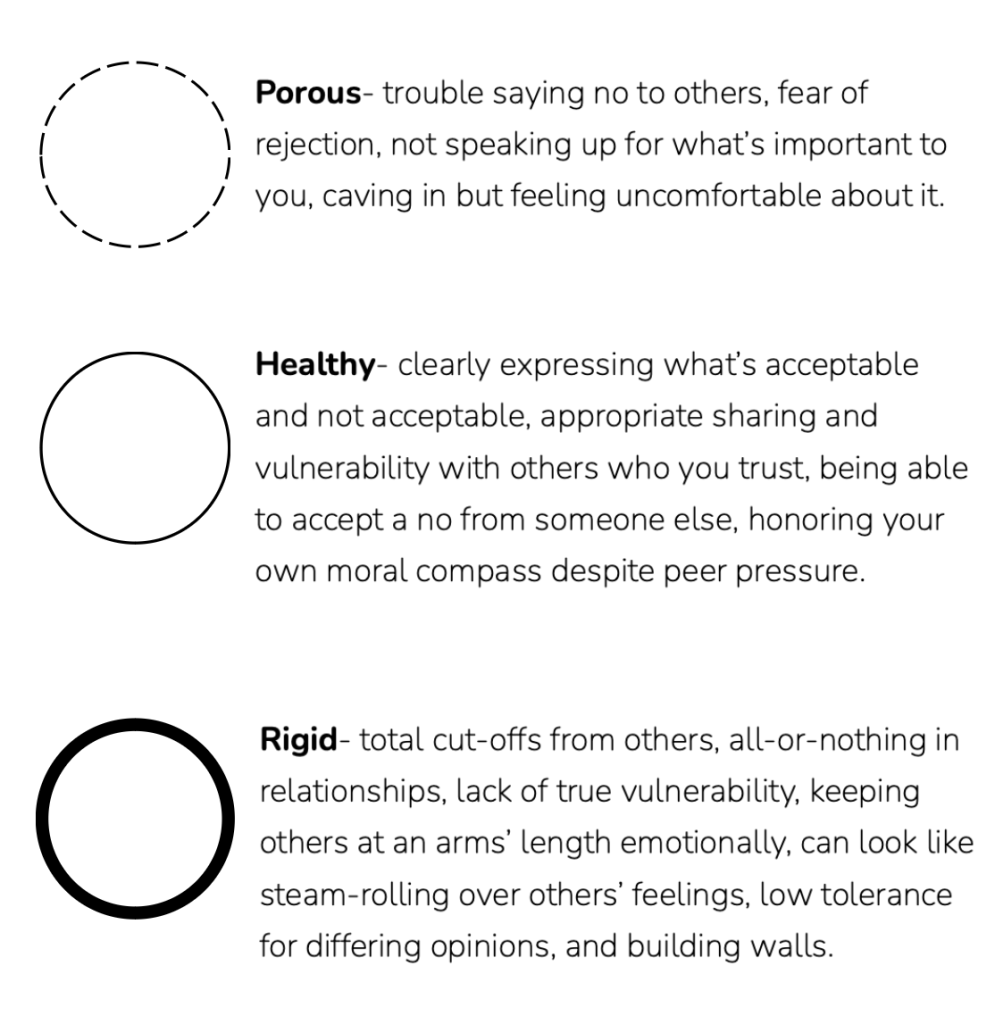
Here are a few examples of types of boundaries. See which one you tend to identify with the best:

Porous, healthy, and rigid boundary types. 

Porous- trouble saying no to others, fear of rejection, not speaking up for what's important to you, caving in but feeling uncomfortable about it

Healthy-clearly expressing what's acceptable and not acceptable, appropriate sharing and vulnerability with others who you trust, being able to accept a no from someone else, honoring you own moral compass despite peer pressure

Rigid- total cut-off from others, all-or-nothing in relationships, lack of true vulnerability, keeping others at an arms' length emotionally, can look like steam-rolling over others' feelings, low tolerance for differing opinions, and building walls

Reflect on your own boundaries. Where have your boundaries been porous, healthy, or rigid? Jot down some situations, people, examples that come to mind. Remind yourself that this is just a taking stock of where things are, not to judge yourself harshly. Let this be neutral, as best you can.

Some boundaries may be helpful or expected in some situations, such as totally cutting off a stalker, becoming much more accommodating than you’d like in a customer service role, etc.

Love and Fear in Setting Boundaries

Love and Fear have everything to do with setting healthy boundaries. Think about it. Porous boundaries are set because you are afraid of the other person. Maybe you’re afraid of disappointing them, afraid that they will refuse to talk to you if you ask for what you need. You may be in an abusive relational dynamic with them, where you are afraid that they will become angry with you or mistreat you if you ask for different boundaries. (If this sounds like you, it is not your fault. Please reach out to a friend, your doctor, or a therapist for help and support). Or, you might be afraid of being disappointed by them yet again, so you’ve learned to lower your expectations all the way to the floor, where people are still stepping on them. Love is transient when you have porous boundaries. It’s nice when it’s there, but you may not feel loved and respected the majority of the time. It’s not a fun place to be, and it certainly doesn’t feel like a safe place to be. You may even get to the point that you don’t have a firm answer for “who are you?”, “what kinds of things do you like?”, or “what are your hopes and dreams?”

When Rigid boundaries are set, love has been choked out of your life by the walls and boundaries you’ve set up. You may have been hurt so many times that it’s just easier not to feel anymore. Walls go up, and you aren’t open and vulnerable in relationships with others anymore, even safe ones. This sort of emotional insulation may be functional in a way, “protecting” you from being hurt by others. But it also leaves you cut off from others, unable to accept care and empathy.

Have you eaten a peach before and found the pit? A spiky, hard-shelled stone in the middle of a peach, it isn’t just something that you can bury in the ground and expect a peach tree to grow. You have to dry out the pit, crack it open carefully with pliers or a nutcracker (so as not to damage the tender seed inside), and go through a 6-week process of germinating the seed ALL before it can go into the ground and start to grow. This pit is a structure meant to protect the seed from being gobbled by a bird or squirrel before it has a chance to grow, but it will 100% prevent its’ growth without any intervention. Having rigid boundaries with everyone in your life is akin to paving over a beautiful garden with concrete, because you don’t want someone to step on the flowers.

In contract, healthy boundaries look like acknowledging that your needs and others’ needs are both important. It is speaking up for what you need in love, setting boundaries where they are needed. It’s not dumping your needs in the garbage; it’s loving your neighbor as yourself. Setting healthy boundaries may upset other people, but that doesn’t mean that you were wrong to set those boundaries. Even Jesus set boundaries with other people. At the end of a day of ministry, the gospels often describe Him as withdrawing by Himself to a quiet place to pray to His Father. Jesus was a man followed by massive crowds on a regular basis, people who wanted to hear him preach, see miracles, get healed, and more. Many, many people had big demands for His time! But He set boundaries around his time with God. He said “no” to what were good things (ministry, healings) to be able to say “yes” to what was better- connection with our Heavenly Father. And I’m sure that many people were disappointed by that. And yet Jesus never sinned. He loved perfectly, and “perfect love casts out fear” (1 John 4:18). Because of this, he was free to set healthy boundaries in the contexts of all relationships in his life.

It is not a bad thing to set healthy boundaries with others. In fact, the Bible urges us to “above everything else, guard your heart. It is where your life comes from” (Proverbs 4:32). We need God’s presence with us and His word to guard our hearts and help us live with healthy boundaries. The Lord says in Isaiah 26:3 that He gives true peace to people to trust in Him. We need His help to decipher if our boundaries are in the right place, and if not, what to do about it.

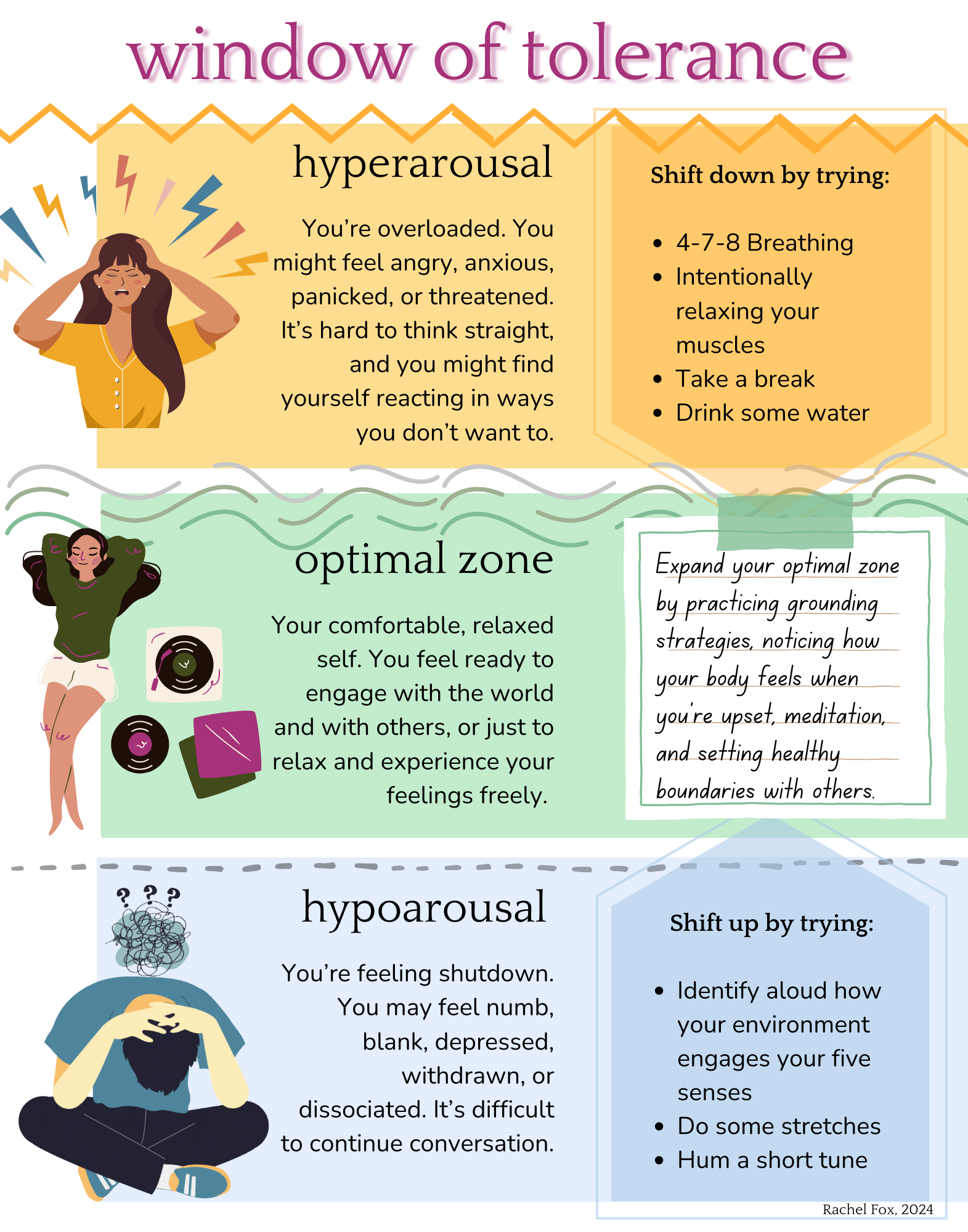
Our Stress Response System

One of the signals that the Father has given us to help us discern when boundaries have been crossed are emotions. When our boundaries (healthy, rigid, or porous) are crossed, you experience reactions. Anger, depression, sadness, apathy, or assertiveness may be emotions that you notice when your boundaries are crossed.

Side note here, emotions are not always reflective of reality. I can get all wound up that a friend is “intentionally” ignoring my phone calls and conclude that they must hate me now. But it could be that they accidentally dropped their phone in the toilet that day and couldn’t respond. We are warned that “the heart is deceptive and desperately wicked; who can understand it?” (Jeremiah 17:9). We can find ourselves triggered by a situation, but it could be that we had uncommunicated, unrealistic, or unfair expectations of the other party. This signaling system that God gave us, originally created good, has been tainted by sin and the fall. As such, our emotions need to be carefully examined and held up in prayer, not regarded as 100% reliable.

“Understand this, my Christian friends: We must all be careful to listen. We should not be too quick to speak. We should not get angry quickly.”

James 1:19

Building Awareness of our Emotional Reactions

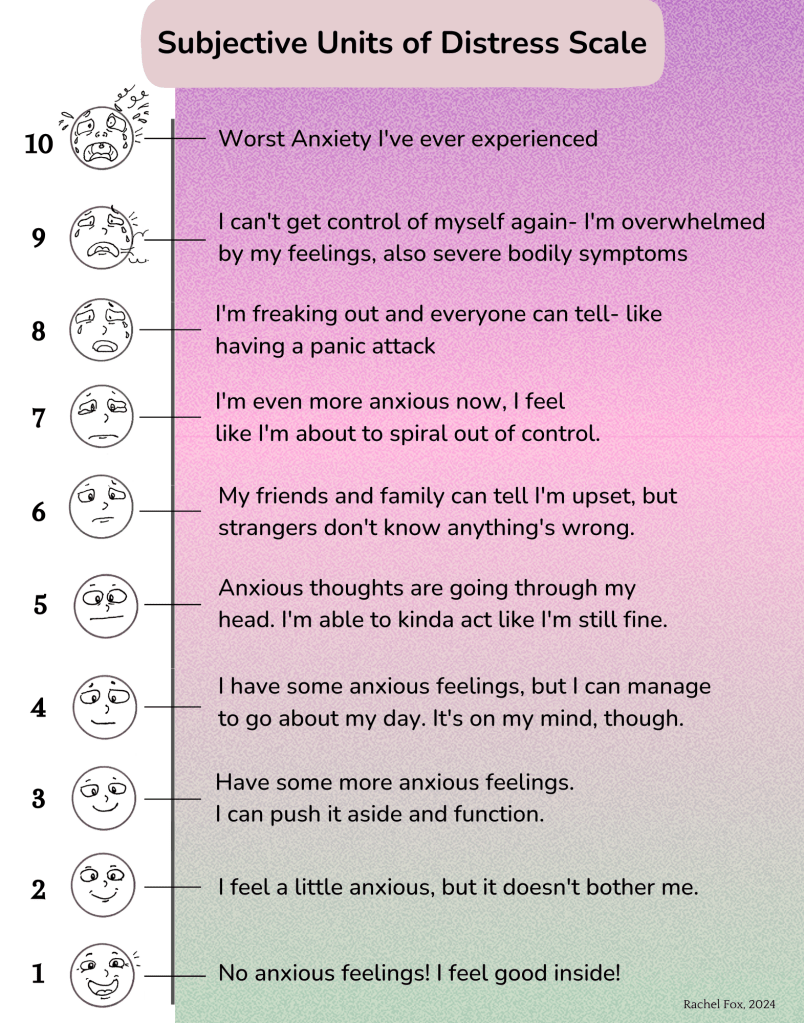
It’s important to be discerning with our emotional reactions, not to be swept away with every stray breeze that blows. To understand your responses to crossed boundaries, I need to draw your attention to your awareness of your own self. Your experience in a stressful situation as it is happening. Just how upset are you? Are you still able to think and talk clearly? Or are you past that point of calm? Check out this graphic below that I use regularly with clients.

Subjective Units of Distress Scale for Anxiety 1-10

Between 1-7, it is much easier to think about and decide how you want to respond to an anxiety-provoking situation: set firmer boundaries, compromise, listen some more to the other person’s perspective, take a break, whatever you may want to do. You are much more in the drivers’ seat, acting in accordance with how you want to act and behave in that stressful situation.

However, once you hit around 7 and above, your brain switches on the stress response system, the thinking brain becomes much less active, and you will typically see one or more of the four reactions:

Fawn
Sparkly, wide eyed adorable kitten saying "I'm harmless and could never hurt you! NOT A THREAT"

Fawning is an attempt to appear as harmless as possible as a means of avoiding or ending the conflict. This person may take on childish characteristics or ways of speaking, may become very overly accommodating, or say whatever they feel the other person wants to hear. The goal of fawning is to end conflict or avoid conflict altogether. Later on, you may hear yourself defending the other person’s inappropriate behaviors. You might make excuses for them, or minimize the impact they had on you.

Freeze
Frozen deer in the headlights with large eyes and its mouth hanging open

Freezing happens when the brain flips over into threat mode. The prefrontal cortex, the thinking and planning part of the brain, becomes much less active. This makes it hard to think clearly, get words out of your mouth, think of options, or even move. Even though you know you’re in danger, it feels that you can’t do anything about it once you’re frozen. Freezing up in a threatening situation isn’t your fault; it’s your brain’s attempt at protecting you. At its far extreme, your body may involuntarily pass out. This unresponsiveness is, again, the body’s attempt to bring calm and homeostasis back to yourself. Later on, you may feel that there are gaps in your memory when it comes to recalling this stressful confrontation. Literally, your brain’s ability to form new memories was impeded when you switched into frozen mode. It’s no wonder details are hard to recall.

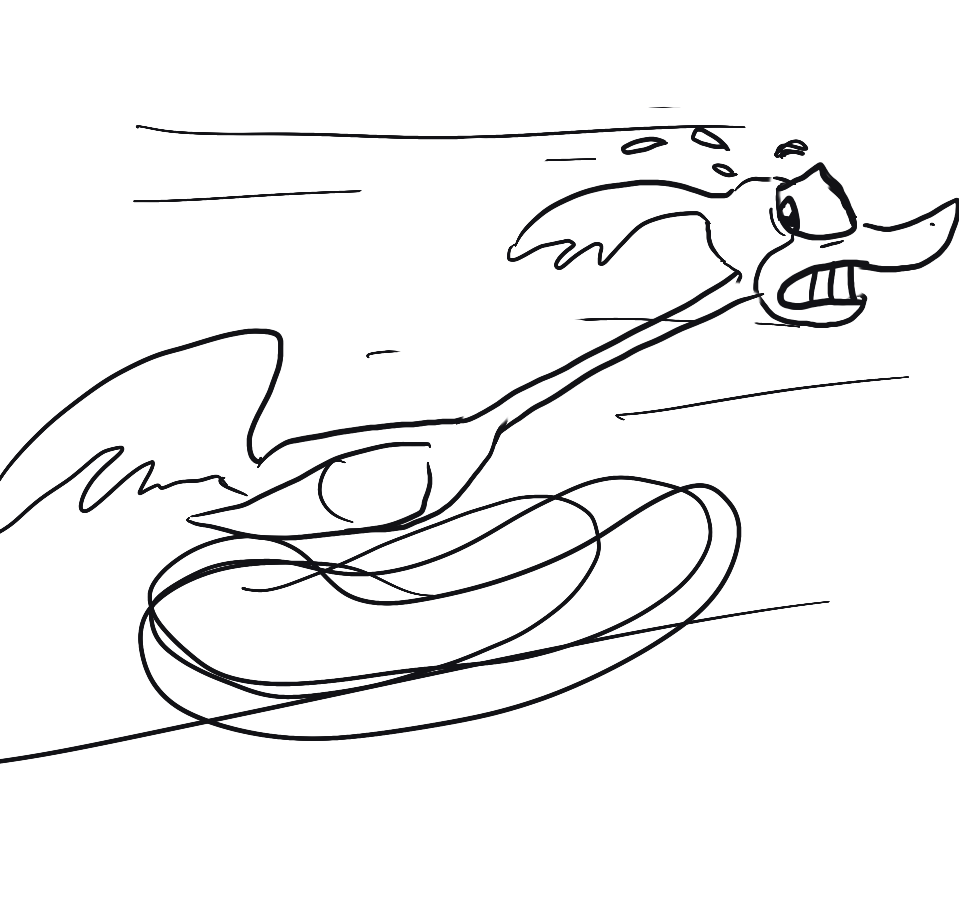
Flight
Frightened cartoon road runner running from something while sweating

This response to threat is one of increased energy. You are suddenly very antsy, looking for the nearest door, trying to come up with excuses for leaving all of a sudden. You may start sweating or feel panic attack symptoms. If there was an “Eject” Button that would rocket-boost you and your seat out of that place, you would punch it in a heartbeat. Later is when you think of all the things that you wish you would have said in the situation.

Fight
Growling, scary lion

The gloves are off now. This can sound like passive aggressive comments, confrontation, louder voices, cussing. It can look like angry faces, tense bodies, and even physical force if taken to its extreme. If taken to its extreme, you start to “see red”. Your brain is attempting to protect you by fighting off the perceived threat, but you may really regret what you did and said later when you are calmer.

Your Stress Response System: Subconsciously trying to protect you

We are good at consciously differentiating emotional tension from someone threatening us with a knife; but our subconscious brains are not. Anything that triggers our threat response (7 or above on the SUDS scale), whether someone stole our cookie, accused us of being irritating, we flopped a work presentation, or someone is trying to mug us- all can initiate the same body and brain reactions because our reacting stress response system (SUDS 7-10) can’t differentiate threat levels the way our think-and-respond brains can (SUDS 1-6).

The goal is to use de-escalation strategies before level 7, when we still have access to the thinking parts of the brain. When we can think and respond, instead of blindly reacting. Even at these lower levels of activation, stress is still stressful. Obviously. You may experience uncomfortable sensations such as:

  • Shortness of breath
  • Pounding heart
  • Sweatiness
  • Upset stomach or gut
  • Suddenly too much energy, antsy
  • Suddenly your energy takes a dive, exhausted

But if you are able to start identifying strategies to calm yourself down once you’ve identified that your stress level has escalated, then you can start to be able to respond more like you’d like to, and much more comfortably. Those bodily stress symptoms only worsen as your stress levels increase. It’s very difficult and uncomfortable to be up at a level 8, while trying to have a conversation with a significant other about household chores and parenting. That conversation is much more productive if you are able to engage in that conversation when you are down at a level 2 or 3 instead.

For strategies and resources you can use to help calm yourself down when you notice that you are reacting to stress, check out my post on “Understanding Stress: Problems and Solutions”. Additionally, you can also read through my post on “How Jesus Handled Anxiety and Suffering” for a Biblical lens on the issue.

Take care, friends,

Rachel

Break Free from People Pleasing with God’s Truth

People Pleasing is a trauma response

“When a friend asks me out to dinner and I know I don’t have the budget, I tell them yes anyway because I don’t want to miss out.” 

“I feel overwhelmed most of the time.” 

“I don’t know who I am anymore.”

“I apologize for everything that goes wrong.”

“I’m afraid of inconveniencing other people.” 

“I feel like a burden to others- I’m constantly failing.”

This is some of what people pleasing in action sounds like. It’s a fear of upsetting others, coming off as mean or rude, and ultimately a fear of rejection and abandonment. This can be something small, like not speaking up for how you really feel on an online post, or something bigger, like setting boundaries with a close friend. Saying “no” can feel very uncomfortable, especially if you are not used to doing it. 

Many times, unhelpful behavior patterns that we notice in adulthood have their roots in childhood.

-Emotional Neglect 

-Parentification- being forced to care for yourself, your siblings, or even your parents while you were still a child 

-Alcoholism in the household 

-A lack of boundaries and self-care modeled by your caretakers 

-Authoritarian parenting style- i.e., the parent is always right, a difference of opinion is “disrespectful”, my feelings are not as important as other people’s feelings 

-Childhood experiences of trauma- bullying, divorce, death of a loved one, housing or food insecurity, abandonment, incarcerated parent, a bad accident or medical emergency/illness, verbal abuse, physical abuse, sexual abuse, witnessing domestic violence in the household

These messages of rejection are the very thing that have us desperately chasing after approval from others. God designed us for connection. Healthy connection with others looks like loving, caring relationship where we encourage each other and are mutually encouraged ourselves. Above even this, though, God designed us for relationship with Him. Our hearts will not be at rest until we rest in the security of our relationship with Him. June Hunt comments, “only the loving, accepting voice of God is powerful enough to override and eventually silence the voices of rejection- and thus salvage the self-worth of” these wounded and rejected parts of yourself. 

The Lord is close to the brokenhearted and saves those who are crushed in spirit. Psalms 34:18

Hope for Healing

The good news is that these behaviors you developed to cope with your negative life experiences, whether from childhood or more recent, don’t have to continue to be your pattern of living.

I would be remiss if I didn’t point you to the Lord first and foremost. He is the healer and the One who knows our hearts best. He is the One who is able to heal and restore our hearts to health. He is the most important ingredient in your journey towards better mental health, because He is the Designer of mental health. So, take a deep breath. You’re going to need to allow God to search your heart and reveal some of these core hurts to you. Yes, it is going to be difficult to sort through these things, but you are not alone. And the Lord is such a gentle and compassionate God, who longs to “bind up the brokenhearted” (Psalm 147:3). Read this section aloud as a prayer to the Lord: 

Lord, I have been so hurt in my past. And a lot of it has been buried so deep, that it’s hard to even call to memory anymore. I ask that you reveal to me the negative messages that I’ve internalized, that still need to be uprooted. I trust you Lord. Amen.

Identify some negative messages that you’ve received in the past- whether from a parent, a peer, a coworker, etc- that need to be challenged by the Word of God. These are messages that may play repeatedly in your head. They may cause you anxiety, sadness, hurt, or anger. They will sound like accusations, and probably feel very true to you. I know this will feel icky, but go ahead and actually write them down on a piece of paper somewhere.

Countering Lies with Truths from God’s Word

If you haven’t read the post about thought fighting, it’s worth going back to just for a refresher. Ready? We are going to use the word of God to start to combat these beliefs that have developed within you for a long time. And I know that your brain is going to try to throw these out with the garbage, insisting that “yeah, this is true for other people but not for me”. It’s going to take intentional effort over a long period of time to start to build this belief that these promises of God are also true for you as well. It’s not easy, it doesn’t feel comfortable, but it is worth it. Think about someone in a crazy car wreck who breaks both their legs. They are a mess even after surgery. It takes rehabilitation and physical therapy to restore the health of their legs through a long period of intentional exercise, stretching, and practice. Your brain also works the same way. Give yourself A LOT of grace where this thought fighting process is concerned. Change rarely happens overnight.

It’s so important to remind yourself of truth, and to practice preaching it to yourself on a daily basis. God knows exactly how our neurochemistry works, and he encourages us in Romans 12 to be careful not to “copy the behavior and customs of this world, but let God transform you into a new person by changing the way you think. Then you will learn to know God’s will for you, which is good and pleasing and perfect.” God knows that what we practice is what we become. And like a fish tepidly swimming with the current, we can quickly find ourselves swept away in the culture’s ideas of what a flourishing life looks like, instead of what God has to say about His plan for our lives. How do we change the way we think? By spending time with God, spending time in prayer and in His Word. Meditating on the Scripture is “[fixing] your thoughts on what is true and good and right. [Thinking] about things that are pure and lovely, and [dwelling] on the fine, good things in others. [Thinking] about all you can praise God for and be glad about” is how you invite God’s peace that surpasses understanding into your mind and your heart (Philippians 4:8). “God’s peace, which is far more wonderful than the human mind can understand…will keep your thoughts and your hearts quiet and at rest as you trust in Christ Jesus” (Philippians 4:7). And neuroscience has shown again and again that neurons that fire together, wire together. You strengthen those neural connections when you practice thinking about something, whether it is truth from God’s Word or an unhelpful and untrue accusation from the enemy. Take a look at some of these truths from God’s word:

  • God breathed into your nostrils the breath of life (Genesis 2:7)
  • You are fearfully and wonderfully made in His image (Psalm 139:14)
  • God has crowned you with glory and honor as the pinnacle and final act of the six days of creation (Psalm 8:5; Genesis 1:26)
  • While you were still a sinner, Christ died for you. While you were still hostile toward Him, you were reconciled and reconnected with God by the death of His Son (Romans 5:8, 10
  • Sin doesn’t have the last word on your life; grace does (Romans 5:20)
  • Everyone who calls on the name of Jesus will be saved (Romans 10:13
  • You are no longer an orphan; you belong to the Lord (John 14:18; 1 Corinthians 6:19)
  • Your perfect Father dearly loves you (1 John 3:1; Luke 15:20–24)
  • You are finally free from the slavery of sin and death. There is now no condemnation for you (Romans 8:1–2)
  • Your position as a child of God is utterly secure; nothing will be able to separate you from His love for you in Christ Jesus (Romans 8:39)
  • God has promised to never leave you nor forsake you (Hebrews 13:5)
  • As you seek God and see more of His glory, He is transforming you more and more into the image of His Son (2 Corinthians 3:18)
  • Through Jesus you are victorious (1 Corinthians 15:57)
  • You have a glorious future (Romans 8:18)
  • One day, God will wipe away every tear from your eyes, and death shall be no more, neither shall there be mourning, nor crying, nor pain anymore. You will be completely freed from the effects of sin. (Revelation 21:3–4

Friend, if you have surrendered your life to Jesus and invited Him to come live in your heart, all of these statements are true about you. You can cling to His promises! I know, I know, it’s especially difficult to cling to His promises and remember the truth about who He says we are when I am going through suffering. When life is all rain and no rainbows. When every day feels like dragging through life with a wet blanket draped over your shoulders. And people-pleasing is one of those long-established, heavy burdens that seems to become just a baked-in part of life. When trauma has literally changed your brain and thinking to where everything feels dangerous. The Lord wants to heal you. And He is explicit in His Word on how we are to deal with this sort of suffering. Check out this passage from Matthew 4: 1-11:

Then Jesus was led out into the wilderness by the Holy Spirit, to be tempted there by Satan. For forty days and forty nights he ate nothing and became very hungry. Then Satan tempted him to get food by changing stones into loaves of bread. “It will prove you are the Son of God,” he said. But Jesus told him, “No! For the Scriptures tell us that bread won’t feed men’s souls: obedience to every word of God is what we need.” Then Satan took him to Jerusalem to the roof of the Temple. “Jump off,” he said, “and prove you are the Son of God; for the Scriptures declare, ‘God will send his angels to keep you from harm,’ . . . they will prevent you from smashing on the rocks below.” Jesus retorted, “It also says not to put the Lord your God to a foolish test!” Next Satan took him to the peak of a very high mountain and showed him the nations of the world and all their glory. “I’ll give it all to you,” he said, “if you will only kneel and worship me.” “Get out of here, Satan,” Jesus told him. “The Scriptures say, ‘Worship only the Lord God. Obey only him.’” Then Satan went away, and angels came and cared for Jesus.

Did you notice that Jesus countered these temptations and accusations with Scripture? We can use the same methods of warfare in combating the enemy and his lies. The Lord has not left us unequipped or alone in this fight. Paul explains more about how we are to fight back in Ephesians 6:

Last of all I want to remind you that your strength must come from the Lord’s mighty power within you. Put on all of God’s armor so that you will be able to stand safe against all strategies and tricks of Satan. For we are not fighting against people made of flesh and blood, but against persons without bodies—the evil rulers of the unseen world, those mighty satanic beings and great evil princes of darkness who rule this world; and against huge numbers of wicked spirits in the spirit world. So use every piece of God’s armor to resist the enemy whenever he attacks, and when it is all over, you will still be standing up. But to do this, you will need the strong belt of truth and the breastplate of God’s approval. Wear shoes that are able to speed you on as you preach the Good News of peace with God. In every battle you will need faith as your shield to stop the fiery arrows aimed at you by Satan. And you will need the helmet of salvation and the sword of the Spirit—which is the Word of God. Pray all the time. Ask God for anything in line with the Holy Spirit’s wishes. Plead with him, reminding him of your needs, and keep praying earnestly for all Christians everywhere.”

Pray through this passage in Ephesians 6. Ask the Lord to equip you with His armor. Then, rebuke these false beliefs that have glommed onto you somewhere along the way. Quote Scripture you found that can combat each one, and call those negative accusations out as lies. You can write the rebuttal scripture out on the page that you wrote the original negative beliefs on.

Ask the Lord to change your heart, to release you from believing they are true about you. You may even find it helpful to memorize these Scriptures so they are mentally accessible to you any time. Don’t be discouraged that things aren’t instantly changed. It took a long time for your heart to believe these unkind and unhelpful things about yourself, and it is going to take a while to build new ways of thinking and feeling. Loop in a trusted friend who can be a prayer partner with you in this fight. Not only will they also seek the Lord’s face on your behalf, but they can be a valuable source of encouragement for you on the road to healing. The Lord wants to move you from this place of responses to past trauma to seeing yourself the way He sees you: loved, valuable, and precious to Him. You are not a burden to Him; you are a joy to Him.

Come check in again next week as I take a look at boundaries!

Living Out God’s Love: A Christian’s Guide

Honoring God with our actions and motivations

How does a Christian, one who has been transformed by the inside out by the work of the Holy Spirit, behave?

A Pharisee challenged Jesus one time, asking him, “Teacher, which is the greatest commandment in the Law?” Now, he was asking this to trap Jesus, but essentially the question is “what are we supposed to be doing here? What does God want most of us?”  Jesus replied: “‘Love the Lord your God with all your heart and with all your soul and with all your mind.’ This is the first and greatest commandment.  And the second is like it: ‘Love your neighbor as yourself.’ All the Law and the Prophets hang on these two commandments.” Jesus was telling this dude that God is concerned about our hearts! And about who we love. It’s not about having everything done just so, appearing perfect to others.  And He says as much to a gaggle of Pharisees later, crying “Woe to you, scribes and Pharisees, hypocrites! For you are like whitewashed tombs, which outwardly appear beautiful, but within are full of dead people’s bones and all uncleanness. So you also outwardly appear righteous to others, but within you are full of hypocrisy and lawlessness.” We can never clean ourselves up enough on the outside to be perfect, able to approach a perfect God on our own merit. Don’t fall into the trap of thinking that you have to try to clean yourself up before you are acceptable to God. There is no hope for that, friend. 

God’s love for us: unearned blessings

Check out the parable of the prodigal son:

 Jesus continued: “There was a man who had two sons. The younger one said to his father, ‘Father, give me my share of the estate.’ So he divided his property between them.

“Not long after that, the younger son got together all he had, set off for a distant country and there squandered his wealth in wild living. After he had spent everything, there was a severe famine in that whole country, and he began to be in need. So he went and hired himself out to a citizen of that country, who sent him to his fields to feed pigs. He longed to fill his stomach with the pods that the pigs were eating, but no one gave him anything.

“When he came to his senses, he said, ‘How many of my father’s hired servants have food to spare, and here I am starving to death! I will set out and go back to my father and say to him: Father, I have sinned against heaven and against you. I am no longer worthy to be called your son; make me like one of your hired servants.’ So he got up and went to his father.

“But while he was still a long way off, his father saw him and was filled with compassion for him; he ran to his son, threw his arms around him and kissed him.

“The son said to him, ‘Father, I have sinned against heaven and against you. I am no longer worthy to be called your son.’

“But the father said to his servants, ‘Quick! Bring the best robe and put it on him. Put a ring on his finger and sandals on his feet. Bring the fattened calf and kill it. Let’s have a feast and celebrate. For this son of mine was dead and is alive again; he was lost and is found.’ So they began to celebrate.”

Luke 15:11-24

Notice what happened with the son. He travels all the way back to his father’s house, with pigslop dirty clothes and the shame of functionally telling his father to his face that he wished he were dead, and his father runs to him while he’s still far off, embraces him, and clothes him with sandals, the best robe, and a ring on his finger. What didn’t happen is the father didn’t wait on the porch for the son to drag his feet all the way back to the house. The father didn’t listen to his son while crossing his arms with a disapproving frown on his face. He didn’t tell the son that he would reluctantly take him back- as a servant. This father RAN to his son the moment he spotted him on the horizon. He gave his acceptance to his son without his son doing anything to earn it. He clothed him. And the father threw a huge feast to celebrate his son’s return. 

God loves us the same way. We are freed to live out of the Lord’s full acceptance and approval of us. His massive, overwhelming love for us is both paid for and given by Him alone. Our sins have been paid for on the cross. If you are His child, He is working in your heart everyday to make you more and more like His Son.

God’s will is that we love others the way He has loved us

And Paul, writing to the church in Rome after Jesus had ascended back to heaven, encouraged them in their walk with Jesus, saying to, 

“Be sure your love is true love. Hate what is sinful. Hold on to whatever is good. Love each other as Christian brothers. Show respect for each other. Do not be lazy but always work hard. Work for the Lord with a heart full of love for Him. Be happy in your hope. Do not give up when trouble comes. Do not let anything stop you from praying. Share what you have with Christian brothers and sisters who are in need. Give meals and a place to stay to those who need it. Pray and give thanks for those who make trouble for you. Yes, pray for them instead of talking against them. Be happy with those who are happy. Be sad with those who are sad. Live in peace with each other. Do not act or think with pride. Be happy to be with poor people. Keep yourself from thinking you are so wise. When someone does something bad to you, do not pay him back with something bad. Try to do what all men know is right and good. As much as you can, live in peace with all men. Christian brothers and sisters, never pay back someone for the bad he has done to you. Let the anger of God take care of the other person. The Holy Writings say, “I will pay back to them what they should get, says the Lord.” “If the one who hates you is hungry, feed him. If he is thirsty, give him water. If you do that, you will be making him more ashamed of himself.” Do not let sin have power over you. Let good have power over sin!”

That’s quite the list, eh? This isn’t something that you can muster up in your own effort. Sure, you could put up a front, just performing these behaviors robotically. Maybe nobody would even notice it. And you would receive your approval from other people. Maybe others would start to compliment you on how kind you are, or how giving you are, etc. But the Lord is concerned with the heart, not the outer appearance. God comments in Hosea that “I want you to show love, not offer sacrifices. I want you to know me more than I want burnt offerings.” The basis of which we are empowered to do the good works above, from the heart as to the Lord, is from our love for the Lord God. We aren’t commanded to act like good christians so other people see, we are commanded to “Love the Lord your God with all your heart, and with all your soul and with all your mind.’ Let that sink in. Our lives, this whole world, all of human history…it’s all been about Him and His glory. 

“You are wonderful, LORD, and you deserve all praise, because you are much greater than anyone can understand.”

Psalm 145:3 

One of the chief ways we bring glory to God is extending His loving care to those around us. Jesus, after washing his disciples’ feet, charges them to  “Love one another. As I have loved you, so you must love one another. By this everyone will know that you are my disciples, if you love one another (John 13:34-35)”. That’s not just the people who look and act like us, or our co-workers and friends. That’s not even just our family members, who can be hard to love at times. We are commanded to love all people- regardless of differences in lifestyle, ethic group, political alignment, age, education, etc. We are commanded to show love towards those who are easy to love as well as to those who are difficult to love. And this has to be an outpouring of God’s love through us, because I know I’ve had a difficult time in the past loving and serving people who just get on my nerves. I’ve had to surrender that annoyance to God over and over and ask that He would pour His love through my heart onto this person. God changes our hearts and our minds as we surrender to him.

God is love itself. It’s His character, and He is honored when we reflect his character and strive to love others as well. He emphasizes that loving others is not about outer appearances, but about genuine heart intentions. God commands us to love not just our friends but love everyone, despite differences.

Come back next week as I dig into what the Bible has to say about people pleasing.

Overcoming Negative Thoughts and Anxiety

How our thoughts influence our anxiety

Be careful how you think; your life is shaped by your thoughts” (Proverbs 4:32). Our thoughts are informed by so many sources, the biggest of all our younger years. It is theorized that our upbringing and our parental bonds are some of the biggest influences on how we view ourselves, the story we tell ourselves about ourselves, internally. Do we believe that we are able to handle challenges, asking for help as we need it; or do we tend more on the side of uncertainty about ourselves? Do we feel like we are bothering or burdening others when we do need to ask for help? Or do we avoid asking for help altogether, deflecting or becoming angry because we are internally afraid of rejection if others knew who we really were? 

Do any of the following thoughts sound familiar to you?

I’m not lovable.I have to be perfect. 
I’m not good enough. I am weak.
I’m shameful.I’m worthless.
I should have known better.I’m all alone.
I can’t protect myself.I can’t trust anybody.
It’s not alright to show my emotions.I have to do what other people say.

Friend, if those thoughts sounded familiar to your ears, the Lord has such great compassion for you. His heart throbs with tender love and mercies for you, which are new every morning. He is likened to the shepherd who, upon realizing he had lost a single sheep from his giant flock, left the 99 other sheep and went to find the one sheep who was lost and alone. He is the Good Shepherd, and if you are His child, He has never left you alone for a moment. He wants to heal you of the wounds you have inside. He doesn’t expect you to sort those things out alone- He wants to carry you through processing all those thoughts about yourself that have grown from the way you have been mistreated by important people in your life. 

Many of these above statements have meanings that no longer apply to a redeemed child of God. 

Read through the following passage:

Then Jesus was led up by the Spirit into the wilderness to be tempted by the devil. And after fasting forty days and forty nights, he was hungry. And the tempter came and said to him, “If you are the Son of God, command these stones to become loaves of bread.”  But he answered, “It is written,

“‘Man shall not live by bread alone,
    but by every word that comes from the mouth of God.’”

Then the devil took him to the holy city and set him on the pinnacle of the temple and said to him, “If you are the Son of God, throw yourself down, for it is written,

“‘He will command his angels concerning you,’

and

“‘On their hands they will bear you up,
    lest you strike your foot against a stone.’”

Jesus said to him, “Again it is written, ‘You shall not put the Lord your God to the test.’” Again, the devil took him to a very high mountain and showed him all the kingdoms of the world and their glory. And he said to him, “All these I will give you, if you will fall down and worship me.” Then Jesus said to him, “Be gone, Satan! For it is written,

“‘You shall worship the Lord your God
    and him only shall you serve.’”

Then the devil left him, and behold, angels came and were ministering to him.

Did you notice what was happening? The devil was serving these zingers over the net, “quoting” (read- misquoting) the Bible itself to Jesus. But Jesus immediately quoted the truths about who God is right back at the devil. And notice what else: Jesus hadn’t eaten for 40 days. The Son of Man was literally starving at this point in time. The devil came to tempt him at a time that Jesus was physically and mentally vulnerable. Our body feelings affect how we think, what we do, and our emotions, remember? 

Rebuttals that God gives us

So, consider some of these rebuttals for yourself:

I’m not lovable.God has loved me with an everlasting love. 
I’m not good enough. God knew I wasn’t good enough, so He stepped in for me and paid that price for me. 
I’m shameful.There is no condemnation for those who are in Christ Jesus. 
I should have known better.For all have sinned and fall short of the glory of God… we all sin. 
I can’t protect myself.God hems you in and surrounds you with His protection. 
It’s not alright to show my emotions.God promises to comfort you in your afflictions
I have to be perfect. …but you never are able to be. That’s why God has covered you with Jesus’s righteousness. You are accepted and loved. 
I am weakIn your weakness, He is strong
I’m worthless.God has called you precious and loved. He compares you to precious gemstones, and dances over you in delight. 
I’m all alone.You are a part of the body of Christ, and you have a cherished place in God’s family.
I can’t trust anybody.God says not to put your trust in man, but to trust in the Lord always. 
I have to do what other people say.What’s most important is that you obey the Lord in all things. 

Our thought life is a major part of us that can consciously change and affect. Thoughts may drift into your head, but they don’t have to live in there rent-free. You can engage in thought fighting. “You become what your practice” is an adage that’s attributed to Epictatus, a Stoic philosopher. And it’s absolutely true. The thoughts we repeatedly have shape the connections within our brains’ neurons. Pathways that fire together, wire together. The more you entertain a thought and replay that thought in your head, the stronger it becomes. 


“Do not be conformed to this world, but be transformed by the renewal of your mind, that by testing you may discern what is the will of God, what is good and acceptable and perfect.”

Romans 12:2

Thought Fighting- what’s true and helpful?

I was prepping meals the other day, and I had tossed some chopped onions in a pot and dumped some broth in to cook them. Only after I took a whiff of the pot a few minutes later  did I discover that the broth had gone bad. But by then, it wasn’t enough to drain the onions and cook it in new broth. The rancid flavor of the broth had cooked its way into the onions. Blegh! Allowing worldly wisdom and advice to teach our hearts is something that just happens as a matter of course while living in this world, we don’t need to work at it. We see it on TV, hear it out of other people’s mouths, read about it online and in books, see it on billboards while driving down the road, etc., etc. And what is some of this seemingly good wisdom that we are inundated with everyday? Follow your heart. Pull yourself up by the bootstraps. Your worth is in your work…or your things, or your relationships, or your kids. You can make your own truth. You can only count on yourself at the end of the day. If you’re rich, you’re successful. Happiness is the most important thing in life. 

But Paul wrote to the church at Colossae, urging them to “see to it that no one takes you captive by philosophy and empty deceit, according to human tradition, according to the elemental spirits of the world, and not according to Christ. For in him the whole fullness of deity dwells bodily”. Instead, “we demolish arguments and every pretension that sets itself up against the knowledge of God, and we take captive every thought to make it obedient to Christ.” But how? And now we come full circle to thought fighting.

“Do not be anxious about anything, but in everything by prayer and supplication with thanksgiving let your requests be made known to God. And the peace of God, which surpasses all understanding, will guard your hearts and your minds in Christ Jesus.

Finally, brothers, whatever is true, whatever is honorable, whatever is just, whatever is pure, whatever is lovely, whatever is commendable, if there is any excellence, if there is anything worthy of praise, think about these things.”

Philippians 4:6-8

God has given us a blueprint to use in testing our thoughts. Is this true? Is this honorable? Is this just? Pure? Lovely? Commendable or worthy of praise? Is this excellent? If so, think about these things! On the other hand, if your answer to any of those is no, then what is more helpful and more true to think instead? Turn to the promises of God in the scriptures to help you fight thoughts that aren’t pointing you to the Lord. Check some of these out:

So do not fear, for I am with you; do not be dismayed, for I am Your God. I will strengthen you and help you; I will uphold you with My righteous right hand.”

Isaiah 41:10

“You will keep in perfect peace those whose minds are set on You, because they trust in you.”

Isaiah 62:3

“The LORD himself goes before you and will be with you; He will never leave you nor forsake you. Do not be afraid; do not be discouraged.”

Deuteronomy 31:8

“I will instruct you and teach you in the way you should go; I will counsel you with My loving eye on you.”

Psalm 32:8

“The LORD makes firm the steps of the one who delights in Him; 

though he may stumble, he will not fall, for the LORD upholds him with His hand.”

Psalm 37:23-24

“‘For I know the plans I have for you,” declares the LORD, “plans to prosper you and not to harm you, plans to give you hope and a future.”

Jeremiah 29:11

The LORD will fight for you; you need only to be still.”

Exodus 14:14

And this is only such a small sampling! These are words that you were meant to hear from the Lord, because they are in your Bible. God describes His Word like a sword, “able to pierce through bone and marrow” (Ephesians 6). His Word is powerful and able to cut to the heart of the issue. Use the promises from His word in rebuking thoughts that are not true or helpful. 

I encourage you to take some time and google “negative self-talk examples”. Use this to take inventory of which statements tend to float around in your head. Write them out below. See where you can counter these with the truths about your worth from God’s word, and write these out, too. They may not feel true to you, but forming a habit of thinking a different way is going to take time and repeated, intentional practice. As a word of caution, if you are really struggling with this exercise, you might need help from a close friend, loved one, or even a licensed counselor to help you start to combat these thoughts. 

Our only hope in this fight is clinging, body and soul, to King Jesus. He paid the price that we could not pay so we could live in relationship with Him. And He did not just win us a “get into heaven free” card. He came to give you abundant life now. (John 10:10). He has declared that “if anyone is in Christ, he is a new creation. The old has passed away; behold, the new has come. All this is from God, who through Christ reconciled us to himself”. (1 Corinthians 5:17-18) You are a new creation, and you are not alone with your thoughts. 

Check out the blog post tomorrow as I continue to take a look at how to honor God with our actions.