How Jesus Handled Anxiety and Suffering

Jesus’ love for us meant his suffering

Jesus, our great High Priest, was no stranger to anxiety. Check out this passage from Matthew where Jesus prays in Gethsemane prior to being betrayed by Judas:“Then Jesus went with them to a place called Gethsemane, and he said to his disciples, “Sit here, while I go over there and pray.” And taking with him Peter and the two sons of Zebedee, he began to be sorrowful and troubled. Then he said to them, “My soul is very sorrowful, even to death; remain here, and watch with me.” And going a little farther he fell on his face and prayed, saying, “My Father, if it be possible, let this cup pass from me; nevertheless, not as I will, but as you will.” And he came to the disciples and found them sleeping. And he said to Peter, “So, could you not watch with me one hour? Watch and pray that you may not enter into temptation. The spirit indeed is willing, but the flesh is weak.” Again, for the second time, he went away and prayed, “My Father, if this cannot pass unless I drink it, Your will be done.” And again he came and found them sleeping, for their eyes were heavy. So, leaving them again, he went away and prayed for the third time, saying the same words again. Then he came to the disciples and said to them, “Sleep and take your rest later on. See,the hour is at hand, and the Son of Man is betrayed into the hands of sinners. Rise, let us be going; see, my betrayer is at hand.””

Matthew 26:36-46, Emphasis added

Jesus knew what needed to happen. He knew the Isaiah 53 suffering Savior was him. He was faced with the prospects of an agonizing death- torturous physical abuse, shame and public ridicule, mocking and beating, and abandonment by His followers. But incomparably worse than those was the full wrath of God that He alone was going to bear the burden of- He was going to make the full and complete payment for the sins of all of God’s children throughout the millennia. For all of history. Millions of slights, betrayals, wrongdoings, abusive behaviors, murders, murderous thoughts, acts of rape, theft, coveteousness, failures to do the right thing, unrighteous anger, slander, sexual sins, adultery, blasphemy, hatred, filthy language, idolatry, drunkenness, sorcery (fellowship with demonic forces), and the like. 

It would be comforting to think that maybe someone (besides just Jesus) got through life without committing sin. But David speaks directly to this in the Psalms, noting that “none is righteous, no, not one; no one understands; no one seeks for God. All have turned aside; together they have become worthless; no one does good, not even one” (Psalm 53:1-3). We had all together, as humanity, fallen short of any hope of righteousness on our own. We were powerless in our state and could do nothing to remedy our problem of sin and sinful hearts. “Surely [Jesus] has borne our griefs and carried our sorrows; yet we [thought] him stricken, smitten by God, and afflicted. But [Jesus] was pierced for our transgressions; he was crushed for our iniquities; upon him was the chastisement that brought us peace, and with his wounds we are healed. All we like sheep have gone astray; we have turned—every one—to his own way; and the Lord has laid on [Jesus] the iniquity of us all” (Isaiah 53:4-6). Jesus was, is, and will be the only One who was fully Man and fully God. He was, is, and will be the Only one to be able to pay for “the iniquity of us all”- the sins of all of mankind. 

And that was an infinite burden full of grief, sorrows, suffering, and agony according to Mark 26:36. That bit,  “he began to be sorrowful and troubled”, is translated with words of suffering. Deeply distressed. Sad. Troubled, Grieved. Agitated. Sorrowful. Very heavy. Agonizing sorrow. But for me, this causes some confusion. Aren’t we commanded over and over again in the Bible to not be anxious? So how is it that Jesus, who was a perfect man and never sinned, still experienced anxiety?

Jesus’ overflowing love for us

One (worldly) way to cope with anxiety is to turn off your feelings and try not to care anymore. The opposite of anxiety is not apathy. Apathy is present with a lack of love. Jesus was “obedient to the point of death, even death on a cross”- because he was overflowing with love for us. He submitted Himself to the Father’s will, and that obedience led Him to gruesome death and suffering. 

“Yet it was the will of the Lord to crush [Jesus for our sins]; [The Father] has put [the Son] to grief; when [Jesus’] soul makes an offering for [the] guilt [of all of us], he shall see his offspring; he shall prolong his days; the will of the Lord shall prosper in his hand.

God’s will was to have Jesus die for our sins, so we could be made sons and daughters of God. God’s will was accomplished through Christ’s obedience. Now He lives forever.

Out of the anguish of [Christ’s] soul he shall see and be satisfied; by his knowledge shall the righteous one, my servant, make many to be accounted righteous, and [Jesus] shall bear their iniquities.

Christ’s sufferings on the cross paid the price for our sins. His righteousness is imputed to us now when we accept His saving work and accept Him into our lives. His righteousness is now  counted as covering us, and we are no longer trapped in our hopeless cycle of sin and guilt, disconnected from God. We have been made His children, and adopted into His family.  

Therefore [God the Father] will divide [for Jesus] a portion with the many, and he shall divide the spoil with the strong, because [Jesus] poured out his soul to death and was numbered with the transgressors; yet he bore the sin of many, and makes intercession for the transgressors.” 

Isaiah 53:10-12

Jesus was willing to die the death of a criminal, and indeed be viewed as a criminal by his contemporaries. However, there was no wrongdoing found in Him. Instead, He paid for our sins, and more than that, continues to forgive our sins and pray to the Father on our behalf continually. But this gift was bought at great personal cost to Jesus. It was “out of the anguish of His soul”. Matthew’s passage also speaks to this. How/why was this anxiety not sin?

Our anxiety- and God’s response

Anxiety is a very human emotion that we all experience. Life doesn’t go according to plans, which can cause a great deal of anxiety and upset. Sometimes it is experienced in response to very real events, such as war breaking out in your neighborhood. For some, it is living paycheck to paycheck. For others, it may be worrying about hypotheticals that never even come to pass. As Mark Twain put it, “worrying is like paying a debt you don’t owe. I have spent most of my life worrying about things that have never happened”. In all of these cases, worry and anxiety are signals that something is wrong- either real or perceived threat. And there is room to rightly be concerned. Wisdom is present in making contingency plans, or efforts to shore up losses. There is definitely space for grief in these situations. And the Bible encourages us to seek out wise counsel in these sorts of situations, as well (Proverbs 11:14).

“You, however, are [not controlled] by the flesh, but by the Spirit, if the Spirit of God lives in you. And if anyone does not have the Spirit of Christ, he does not belong to Christ.” (Romans 8:9) It all has to do with our hearts, and where we place our sense of control, our anchor. All humans have a basic need for safety. The Lord has taught me that when I functionally live without him, spending days, weeks, or months apart from the Word, with prayerlessness more of a rhythm in my life instead of  the exception; I am choosing to live in the flesh. Depending on my own strength, I am thoughtlessly depriving my own spirit of the power and the life that God would breathe into me every day. And that especially includes the strength and dependability that He wants to be for me in the midst of situations that are completely out of my control. 

When we are faced with impossible situations outside of our control, it can very much cause a storm to brew in our hearts. There are a few responses, look to God to uphold you in the midst of the storm, look inside yourself to figure things out, or look to other things or people to distract you from the pain or try to save you from the situation. Looking to yourself will quite naturally result in anxiety and hypervigilance, because we know that we aren’t in control. We know that we can’t fix things like cancer, or a loved one who has passed away, or a layoff, or a narcissistic parent. To rely on someone or something else to bethe silver bullet that fixes everything is also going to end in disappointment, anger, and anxiety. People make really poor gods. They aren’t in control, either. 

But we know that God is in charge of everything. He holds all the cards. Fully relying on God does not mean “if I pray hard enough, I won’t have suffering in my life”. God is not a gumball machine in the sky, or a butler who can be summoned at will. “In this world, you will have trouble” is what Jesus warned us. Sin is rampant, and the effects of sin are felt everyday. But God is good. 

My mentor once told me that “God’s blessings are sometimes heavily disguised. His ways are not our ways, neither are His thoughts like our thoughts. (Isaiah 55:8) What He does and does not allow in our lives doesn’t make sense to me. But I know (in my head) that all things work together for those who love God. I have these promises on one hand, on the other hand everything is burning down and I’m full of anxiety. What now?

Anxiety in proper context

One thing I want to note before continuing is that sometimes anxiety is a result of brain chemistry being off-balance, and medicine is one of God’s common graces to us. If a doctor is suggesting trying medication to address your anxiety, that doesn’t mean that your faith isn’t strong enough. Again, in this world, we will have trouble. This includes physical and mental health struggles for some folks. Be careful of the prosperity gospel messages that may have infiltrated your heart around this issue. God has not promised us health and wealth in this life. He never said that he was going to cushion us from pain and disappointments. He said to expect suffering in this sinful world, but He has also promised us His continuing presence with us through it all. Anxiety is not a lack of faith– as if I had enough faith I wouldn’t be anxious. There is an appropriate and helpful time and place for medication for some people. Be careful that this doesn’t become a source of shame for you, or a roadblock to receiving medical care.

Rooting ourselves in prayer and connection with God

Do not be anxious about anything, but in everything by prayer and supplication with thanksgiving let your requests be made known to God. And the peace of God, which surpasses all understanding, will guard your hearts and your minds in Christ Jesus.”

Philippians 4:5-7

The way we are encouraged to address anxiety is again, a very similar method to how the Bible encourages us to deal with suffering. Paul urges the Philippians to turn to the Lord, laying their needs and requests before the throne of grace with thankfulness in their hearts. The trick is not relying on ourselves, but turning our anxious hearts to the Lord. We thank the Lord for His precious promises that He has given us, and He gives us His “peace that surpasses understanding”.

He, in response to our obedience to turn to Him in prayer, guards our emotions and our thoughts in the midst of whatever anxiety-provoking situation we may find ourselves in. The answer to anxiety is more of Him. Because He is never taken off guard. He is never surprised by events. He is more than we can understand. “We have access to the peace of God, because we are at peace with God” according to Jamin Roller, a pastor at Citizen’s Church. If you are His child, He is always with you. God doesn’t shame us for our sadness or anxieties, instead He encourages us to “cast all your anxieties upon Him because for He cares for you” (1 Peter 5:7).

Tune back in tomorrow as I continue this blog post, talking about how God addresses our anxious thoughts.

Overcoming Shame: Insights on Healing and Forgiveness

What to do with shame?

Ooh, shame. This is such a tricky one. First off, I want to clear up what shame isn’t. Shame and guilt aren’t synonymous. Guilt is feeling badly for something you’ve done- breaking the rules or the law or sinning. Shame is feeling bad at the core of who you are- I am a horrible person, I’m a screw-up, I’m a waste of time, I’m bad. False guilt is feeling guilty for something that’s not your fault, and this can happen quite often in dysfunctional relationships or when you feel intense shame at your core. 

Secular counseling would point us towards more awareness as the first step in combating shame. Nonjudgemental noticing of the thought as it comes up in your mind, and finding ways to speak more gently and kindly to yourself instead. Another important part of dealing with shame is recognizing where it comes from- past trauma and the like. Speaking to the parts of yourself that feel shame, or the parts of you that are scared, angry, etc can also be helpful in addressing and understanding where these shameful messages originated. Talking with others about your shame can also be incredibly helpful, as safe, empathic connection is healing. Friends, as helpful as a warm, kind listening friend is to healing shame, bringing our shame into the loving arms of our Savior is where we find full healing. And He wants to completely heal us of our shame. 

Origins of Shame

 Shame didn’t exist in mankind prior to the fall. Genesis tells us that “the man and his wife were both naked, and they were not ashamed” (Genesis 2:25). There was no sin or wrongdoing to hide; they had no need to cover themselves, or try to explain away a sin, or manipulate others. They were living in perfect relationship with God and with each other. But we know that that utopia didn’t last. With their disobedience, they both realized the repulsiveness of their sin, their inability to do anything about it, so they tried to cover themselves with fig leaves, hid from the Lord, and they both blame-shifted and made excuses when confronted about it. They weren’t able to do anything to clean themselves up. So sin was brought into the world and cursed all of creation.  We know that “all have sinned and fall short of the glory of God” (Romans 3:23). It’s because of this very ability to see our own shortcomings, hear our own internal dialogue, be privy to all of our deepest desires, that we are overcome by shame. We know that we fall short of perfection. We, by the Holy Spirit, see the repugnance of our sins, and we realize that we can’t do anything to fix that. We are in a helpless state. 

But. For. Christ. 

“There is therefore now no condemnation for those who are in Christ Jesus. For the law of the Spirit of life has set you free in Christ Jesus from the law of sin and death. For God has done what the law, weakened by the flesh, could not do. By sending his own Son in the likeness of sinful flesh and for sin, he condemned sin in the flesh, in order that the righteous requirement of the law might be fulfilled in us, who walk not according to the flesh but according to the Spirit.”

Romans 8:1-4 

Simply knowing that we are sinful could never save us- that’s what the law does. It shows how far we fall from the standard, but can only ever offer us punishment. This is where our shame makes sense. We are intrinsically sinful. Even David confesses that he “was brought forth in iniquity, and in sin did [his] mother conceive [him]. For [he] was born a sinner— yes, from the moment [his] mother conceived [him]” (Psalm 51:5) Yet, “while we were still weak, at the right time Christ died for the ungodly” (Romans 5:6). He knew that we wouldn’t be able to pay the price for our own sins. 

Once you were dead because of your disobedience and your many sins. You used to live in sin, just like the rest of the world, obeying the devil—the commander of the powers in the unseen world. He is the spirit at work in the hearts of those who refuse to obey God. All of us used to live that way, following the passionate desires and inclinations of our sinful nature. By our very nature we were subject to God’s anger, just like everyone else. 

But God is so rich in mercy, and he loved us so much, that even though we were dead because of our sins, he gave us life when he raised Christ from the dead. (It is only by God’s grace that you have been saved!) For he raised us from the dead along with Christ and seated us with him in the heavenly realms because we are united with Christ Jesus. So God can point to us in all future ages as examples of the incredible wealth of his grace and kindness toward us, as shown in all he has done for us who are united with Christ Jesus. 

God saved you by his grace when you believed. And you can’t take credit for this; it is a gift from God. Salvation is not a reward for the good things we have done, so none of us can boast about it. For we are God’s masterpiece. He has created us anew in Christ Jesus, so we can do the good things he planned for us long ago.”

Ephesians 2:1-10

Our sin meant separation from God. However, “if anyone is in Christ, he is a new creation. The old has passed away. Behold, the new has come! All this is from God, who reconciled us to Himself through Christ” (2 Corinthians 5:17-18a) We are now reconciled, reconnected to God. We are given complete forgiveness of sins; past, present, and future. We are no longer under condemnation. “He forgave us all our sins, having canceled the charge of our legal indebtedness, which stood against us and condemned us; he has taken it away, nailing it to the cross” (Colossians 2:13b-14). All you have to do is “confess with your mouth, “Jesus is Lord,” and believe in your heart that God raised Him from the dead, you will be saved. For with your heart you believe and are justified, and with your mouth you confess and are saved. It is just as the Scripture says: “Anyone who believes in Him will never be put to shame” (Romans 10:9-11). 

Because we are in Christ, we no longer have shame attached to us. Your life is now “hidden with Christ in God” (Colossians 3:3b). We are in right standing and relationship with God forever. Jesus has promised that “whoever comes to me I will never cast out” (John 6:37b). His saving work is all-encompassing and eternally binding.

Already and Not Yet

Yet we still struggle with sin. Paul struggled mightily under this weight and wrote to the Roman church about it: “I know that nothing good dwells in me, that is, in my flesh. For I have the desire to do what is right, but not the ability to carry it out. For I do not do the good I want, but the evil I do not want is what I keep on doing. Now if I do what I do not want, it is no longer I who do it, but sin that dwells within me.

So I find it to be a law that when I want to do right, evil lies close at hand. For I delight in the law of God, in my inner being, but I see in my members another law waging war against the law of my mind and making me captive to the law of sin that dwells in my members. Wretched man that I am! Who will deliver me from this body of death? Thanks be to God through Jesus Christ our Lord! So then, I myself serve the law of God with my mind, but with my flesh I serve the law of sin” (Romans 7:18-25). Paul very much acknowledged the struggle of his flesh, his fallen, sinful side, and the desire to follow the promptings of the Holy Spirit working in his new, redeemed self. You can see the intensity of his struggle as he calls himself “wretched” and in a “body of death”. Eesh. We still live in a sinful world. We still struggle with sin and are tempted. We still choose the wrong way sometimes. Maybe often. The good news is that God looks at us and sees Christ’s righteousness covering our sins. He paid for them completely. “But you were washed, but you were sanctified [notice the past tense], but you were justified in the name of the Lord Jesus and by the Spirit of our God” (1 Corinthians 6:11b) This washing, this setting aside for His special use, this justification in His sight happened at the moment of conversion. Our shame- gone. Our sins- forgiven forever. Our slate cleaned. Our lives “hidden with Christ in God”. We were called by a new name, we were called to a new purpose, we were given new life. 

God calls us to an eternal hope

And God continues to change us from the inside out, knowing that we still struggle with sin. “If we confess our sins, he is faithful and just and will forgive us our sins and purify us from all unrighteousness” (1 John 1:9). He purifies us on a regular basis, so we can confidently come before the throne of grace. “Such is the confidence that we have through Christ toward God. Not that we are sufficient in ourselves to claim anything as coming from us, but our sufficiency is from God, who has made us sufficient to be ministers of a new covenant, not of the letter, but of the Spirit” (2 Corinthians 3:4a-6). Our reconciliation, our acceptedness, is rooted in God’s gift to us. It was 100% His work. And He not only reconciled us, but He wants us to participate in His work of reconciling others to Himself. 

“Since we have such a hope, we are very bold…Now the Lord is the Spirit, and where the Spirit of the Lord is, there is freedom. And we all, with unveiled face, beholding the glory of the Lord, are being transformed into the same image from one degree of glory to another. For this comes from the Lord who is the Spirit. “

(2 Corinthians 3:12, 17-18)

His desire is to free us from slavery to sin and shame, and to lead us into ever-increasing freedom as we enjoy Him, glorify Him, and become more like Him day after day. It is a long faithfulness in the same direction which comprises the Christian walk. 

True Guilt vs False Guilt

Paul talks about guilt in the New Testament. “As it is, I rejoice, not because you were grieved, but because you were grieved into repenting. For you felt a godly grief, so that you suffered no loss through us. For godly grief produces a repentance that leads to salvation without regret, whereas worldly grief produces death” (2 Corinthians 7:9-10). This “godly grief” that Paul references in writing to the Corinthians has to do with the guilt and conviction of the Holy Spirit that is felt over sin. Guilty feelings, when experienced in the context of an actual wrong, are meant to point us to repentance. Repentance is a turning away from sin, confessing wrongdoing and asking for forgiveness from the Lord and perhaps from someone you have wronged, and a return to righteous ways of living and relating to others. 

However, I oftentimes will run into false guilt. This is feelings of guilt in the absence of actual sin or wrongdoing. And differentiating guilt from false guilt takes discernment and wisdom. Oftentimes it takes having a conversation with a friend, mentor, or even a mental health care provider to identify this. These negative feelings can be triggered in response to variables outside of our control, such as getting sick, feeling inadequate, or not meeting unrealistic expectations of the self or others. Another big contributor to false guilt is the devil. He is described as “the accuser”, and is out to steal, kill, and destroy. We must rely on the Lord for wisdom around true guilt calling us to godly repentance, and false guilt that only cripples us. If something sounds like an accusation, it probably is. Pray for clarity from the Lord and the wisdom to see the truth of the situation through all of the mess of feelings. 

Feeling True GuiltFeeling False Guilt
Focused on God’s forgivenessShaming- negative “you are” statements
Is specificOften Ambiguous 
You sinned in some wayDidn’t commit a sin
God loves you massively and tenderly calls you to repentanceYou’ve ruined everything. There’s no hope for you now.
God wants to restore youYou have to clean yourself up and get your act together. You’re on probation with God’s forgiveness.
Leads you to freedom and peace with obedience and repentanceLeads you to slavery to self-hate, despair, and depression

Thus says the Lord:
“Cursed is the man who trusts in man
    and makes flesh his strength,[a]
    whose heart turns away from the Lord.

He is like a shrub in the desert,
    and shall not see any good come.
He shall dwell in the parched places of the wilderness,
    in an uninhabited salt land.

“Blessed is the man who trusts in the Lord,
    whose trust is the Lord.

He is like a tree planted by water,
    that sends out its roots by the stream,
and does not fear when heat comes,
    for its leaves remain green,
and is not anxious in the year of drought,
    for it does not cease to bear fruit.”

The heart is deceitful above all things,
    and desperately sick;
    who can understand it?


“I the Lord search the heart
    and test the mind,[
b]
to give every man according to his ways,
    according to the fruit of his deeds.”

Jeremiah 17:1-10

Make sure to continue reading tomorrow as I take a look at anxiety from a Biblical context!

Jesus and Suffering: A Compassionate Perspective

How does secular counseling approach suffering?

Let’s first take a look at the ceiling that secular wisdom would lend to this situation. When we turn to what we can do by our own efforts to address suffering, we often run into some version of ACT, Acceptance and Committment Therapy. ACT aims to improve functionality and psychologic flexibility using six core processes. The six processes are: 

contacting the present moment (taking the time to be aware and take in your current body feelings and experiences),

defusion (challenging thoughts for truth and helpfulness to the current situation), 

acceptance (tolerance of negative thoughts and feelings, focusing on what is in our control), 

self-as-context (we are not our worried thoughts and feelings, we experience worried thoughts and feelings), 

Values (remembering to keep your values in sight, which is hard in the midst of a panicked situation), and 

committed action (setting achievable goals that align with your personal values). 

The above certainly contains helpful tools for all people to use in light of suffering, and it can only take you so far. Eventually, you will hit the ceiling of what you can accomplish on your own, and at that point you will still have suffering to try to cope with. Reaching the end of themselves, folks will typically try to distract themselves from the situation with busyness, try to medicate the pain with a wide variety of techniques (shopping, sex, smoking, drugs, eating, etc.), deny that things are really that bad (minimize their own experiences), or look to something or someone to be their savior. And only God can stand up under the weight of the role of Savior. But all of those attempts at survival will ultimately leave people worse off in the end. This is a problem of the heart that only the One who made the heart can remedy. 

Jesus, a man of sorrows and acquainted with grief

Thankfully, the Bible is far from silent on the topic of suffering. Jesus Himself was described as not really attractive or eye catching, with “nothing to cause us to take a second look. He was looked down on and passed over, a man who suffered, who knew pain firsthand. One look at him and people turned away. We looked down on him, thought he was scum” (Isaiah 53:2-3, MSG). “We don’t have a priest who is out of touch with our reality. He’s been through weakness and testing, experienced it all – all but the sin” (Hebrews 4:15, MSG). We have a Savior who can empathize with our suffering and our sorrows, because He experienced them, too. 

God the Father is not far removed from our sufferings, either. David writes that God has “kept track of all my wandering and my weeping. You’ve stored my many tears in your bottle—not one will be lost. For they are all recorded in your book of remembrance” (Psalm 56:8). Our Heavenly Father sees our sadness and mourning and takes note of it. He responds with tender mercies, promising to “[heal] the brokenhearted and [bind] up their wounds” (Psalm 147:3) He is described as “the Father of mercies and God of all comfort, who comforts us in all our affliction” (2 Corinthians 1:3-4a). But His timing is not our timing, and that can cause confusion and despair as we are waiting. David writes about this exact experience:

“As a deer pants for flowing streams,
    so pants my soul for you, O God.

My soul thirsts for God,
    for the living God.
When shall I come and appear before God?

My tears have been my food
    day and night,
while they say to me all the day long,
    “Where is your God?”

These things I remember,
    as I pour out my soul:
how I would go with the throng
    and lead them in procession to the house of God
with glad shouts and songs of praise,
    a multitude keeping festival.

Why are you cast down, O my soul,
    and why are you in turmoil within me?
Hope in God; for I shall again praise him,
    my salvation and my God.

My soul is cast down within me;
    therefore I remember you
from the land of Jordan and of Hermon,
    from Mount Mizar.

Deep calls to deep
    at the roar of your waterfalls;
all your breakers and your waves
    have gone over me.

By day the Lord commands his steadfast love,
    and at night his song is with me,
    a prayer to the God of my life.

I say to God, my rock:
    “Why have you forgotten me?
Why do I go mourning
    because of the oppression of the enemy?”

As with a deadly wound in my bones,
    my adversaries taunt me,
while they say to me all the day long,
    “Where is your God?”

Why are you cast down, O my soul,
    and why are you in turmoil within me?
Hope in God; for I shall again praise him,
    my salvation and my God.”

Psalm 42

I’m so thankful that God included psalms like this in the Bible. I didn’t understand the emotional impact of sad psalms like this as a child. They started resonating within me as I started experiencing suffering and difficulty as an adult. It became a comfort to me. Our pain is met with compassion. The Lord promises to be “near to the brokenhearted and [save] the crushed in spirit” (Psalm 34:18). He is not scared off or turned off by our suffering and pain; He wants us to “call upon [Him] in the day of trouble” (Psalm 50:15a) 

So, notice how David cries out to the Lord. He doesn’t try to pretend that everything is fine when it’s clearly not. He gives room to his emotions and his experience in a way that honors the Lord. He talks of being mocked and oppressed by enemies. But consider how he describes experiencing this. He tearfully longs for the day he can come before the Lord again in His temple. Perhaps he has difficulty sleeping at night. He may have lost his appetite as he describes his tears as his food “day and night”.  He talks of feeling physically beat down, “all Your breakers and Your waves have gone over me”. He asks God why he has been forgotten and why he is stuck in such a mournful situation in life. He describes his soul as “in turmoil” and “cast down”. This is a psalm of misery and depression. 

Yet, he echoes encouragement to himself within the psalm to “hope in God, for I shall again praise Him; my salvation and my God.”  Even in the midst of asking God what the heck is going on, he emphasizes that God is “his rock”. He reminds himself that “by day the Lord commands his steadfast love, and at night his song is with [him]”. He acknowledges his very real struggles, and reminds himself of what is true. It may feel strange to hold these two things in your hands at once: “stuff really sucks” and “God is still good”. Just because they don’t seem to fit together doesn’t mean they don’t. 

We are encouraged in Romans 12 to “Rejoice in hope, be patient in tribulation, be constant in prayer.” This is the kind of verse, at least for me, that is a great Bible memory verse, but such a challenge to apply when I am the one going through suffering. When I am going through seasons of depression, or am on a shoestring budget, struggle with anxiety, or work and home are both on fire, it is easy for me to cry out to the Lord and ask “Why have you forgotten me?” just like David did. It’s very easy to feel alone, isolated within the pain we are experiencing. It’s easy for the anxiety and panic to start to take over my mental life- to where I am thinking about it constantly whether I like to or not. I’m not telling you that I have this all figured out- far from it. But what this verse is telling us is that we are urged to rejoice even in the face of struggles and tribulations. But this is the exact opposite of what conventional wisdom would point to, and the opposite of what our emotions would point to. It’s hard to put a brave face on a stark situation. The best I can muster up is putting on a mask and pretending the dumpster’s not on fire…which is just toxic positivity. 


God is our anchor in the storms of life


Suppressing your painful emotions, ignoring your problems, internally experiencing guilt over your pain, and putting on a happy face that’s incongruent with your internal experience are all features of toxic positivity. This disconnection with yourself also can lead to a deep discomfort and disconnection with the suffering of others. It can lead you to say super helpful stuff like “at least it’s not worse”, “look on the bright side”, or “everything happens for a reason”- none of which are helpful at all. A culture that idolizes happiness and success doesn’t leave much room for suffering and difficulty. Many of us are short on empathy for ourselves, much less others; and can feel unsure what to say or do when somebody bursts out crying. We don’t have the capacity in our own efforts to respond in a God-honoring way, at least for long. How are we supposed to rejoice in suffering? 

It’s precisely because of this that I am convinced it is only a work of the Holy Spirit within us that can bring us to the place of being able to “rejoice in hope” while experiencing tribulation. It’s not rejoicing in the suffering or finding the silver lining to the dark rain clouds of despair. The hope of glory that we have in Christ is where we must anchor ourselves. We are able to be patient in tribulation because we remember that God is with us and will carry us through it. We are “more than conquerors through Him who loved us. For I am sure that neither death nor life, nor angels nor rulers, nor things present nor things to come, nor powers, nor height nor depth, nor anything else in all creation, will be able to separate us from the love of God in Christ Jesus our Lord” (Romans 8:37b-39). We can rejoice in this hope- that nothing can separate us from His loving protection. We are safe in His hands. 

He never wastes suffering, and it certainly wasn’t what He intended. But because He allowed free will, He allowed a choice for sin to be made, and the world was enslaved to sin as an outcome of that decision. He allows sin and suffering in this world for a short time, then “creation itself will be set free from its bondage to corruption (sin) and obtain the freedom of the glory of the children of God.” (Romans 12:21) In the meantime, He has told us that we will suffer in this present age, but “our light and momentary troubles are achieving for us an eternal glory that far outweighs them all.” (2 Corinthians 4:17). He has promised that “after you have suffered a little while, will himself restore you and make you strong, firm and steadfast” (1 Peter 5:10b). He will restore us to Himself. We will be freed from the struggles of sin and will be glorified. Jesus has assured us that one day “He will wipe every tear from [our] eyes. There will be no more death or mourning or crying or pain, for the old order of things [will have] passed away” (Revelation 21:4) We are currently living in the “old order of things”, which includes death, mourning, crying, and pain.  

In the meantime, we are commanded to be “constant in prayer”. We are to “pursue righteousness, godliness, faith, love, endurance and gentleness.” Fight the good fight of the faith.” (1 Timothy 6:11b-12a) Suffering is real, it is heart-wrenching, and sometimes there’s no clear end in sight. Bring it to the Lord in prayer as you remind yourself of the hope you have in the Lord’s promises and His love poured out on you. Preach the certainty of His love toward you to yourself straight from the Bible. Quote His promises back to Him in prayer, and thank Him for His faithfulness.

“And after you have suffered a little while, the God of all grace, who has called you to His eternal glory in Christ, will Himself restore, confirm, strengthen, and establish you.”

 1 Peter 5:10

We are also given the body of Christ as our community. The body of Christ is called to “rejoice with those who rejoice, mourn with those who mourn(Romans 12:15). We are equipped powerfully with the tools to do this from “…the Father of mercies and God of all comfort, who comforts us in all our affliction, so that we may be able to comfort those who are in any affliction, with the comfort with which we ourselves are comforted by God. For as we share abundantly in Christ’s sufferings, so through Christ we share abundantly in comfort too” (1 Corinthians 1:3b-5). God is where life is found. He is love itself. He is your lifeline, your buoy in the storm, your sure and firm foundation when everything else is uncertain. June Hunt sums it up well: “contentment and fulfillment are found in relationship with the Lord, who is always with you”, even in the midst of suffering. 

Follow this post as I talk about how we can deal with shame from a Biblical perspective.

Healthy Boundaries: The Role of Anger Explained

First, let’s check out the way the world deals with anger. Secular counseling uses methods such as increasing body awareness, developing awareness of triggers, and removing yourself from potentially anger-inducing situations. We also talk to folks about identifying unhelpful thinking patterns, and practicing new, more helpful and true ways of thinking instead. These are some really good methods that can be used to address anger, but again; we are going to go to the One who made the heart and can heal anger and aggression at the source. 

Jesus, the One man who lived a perfect life, also experienced these same emotions, but without sin. “When it was almost time for the Jewish Passover, Jesus went up to Jerusalem. In the temple courts he found people selling cattle, sheep and doves, and others sitting at tables exchanging money. So he made a whip out of cords, and drove all from the temple courts, both sheep and cattle; he scattered the coins of the money changers and overturned their tables. To those who sold doves he said, “Get these out of here! Stop turning my Father’s house into a market!” His disciples remembered that it is written: “Zeal for your house will consume me.” Jesus was disgusted and rightly angry that the temple had been turned from a place of worship to a place of commerce. But boy howdy, can you imagine what this might have been like? Jesus wrecked house. Let yourself imagine the tables of the vendors, the cows, sheep, doves, and all the people milling around in the temple courts. I bet it was loud and smelly! Moos, sheep bleating, people negotiating and dealing, all inside the temple. And Jesus rolls up with this braided whip in his hand. He starts whipping it around, scaring the animals, sending them on a stampede out of the temple grounds. He’s upending tables left and right, scattering coins and all over the ground, and yelling at them to stop selling in His Father’s house. That must have been a huge mess! I wonder how the disciples were reacting. My imagination has them standing by, frozen, with shocked expressions. Maybe thinking something along the lines of what the heck has gotten into Jesus? What is he doing? But there was a big problem that needed to be rectified, and Jesus was going to be the one to cleanse the temple. 

Anger, experienced as God designed, is a signal that a boundary has been crossed. Something is wrong. It motivates us to take respectful, corrective steps. This can mean setting firmer boundaries with others, which they may not like. But we always act in love, obeying God’s will first. 

You’ve seen anger acted upon in a sinful way before, no doubt. When anger is mishandled, the chain of events starts in much the same way. Anger bubbles up, signaling that a boundary has been crossed or an unspoken expectation of ours has been transgressed. But when we don’t check ourselves and rely on the Lord’s strength with this uncomfortable emotion, we can become abusive, belittling, and spiteful toward others as a result. Or we become passive, saying nothing and harboring bitterness inside. While our emotions come and go, we are responsible for what we decide to do with those emotions. I will say more about this later, but James encourages us to be “slow to speak and slow to anger”. He didn’t say to never speak up or never to express anger. He warned us to slow down. That way, we can make a conscious decision, handling our words well and saying what needs to be said in a loving way. 

If you haven’t experienced this already, you will:  obedience to God’s will does not guarantee that things will resolve smoothly. Setting healthy and loving boundaries can cause people to become offended or upset with you. I’m sure those money changers in the temple were upset that Jesus had completely upended their business. A negative response is not necessarily an indication that you were in the wrong or sinning against them. This is why it is so vital to seek the Lord’s will in confusing situations, or even seek the counsel of other godly people in your life. 

Check out the next post tomorrow when I talk about how to handle suffering.

Understanding Emotions: A Christian Perspective

Hey friends,

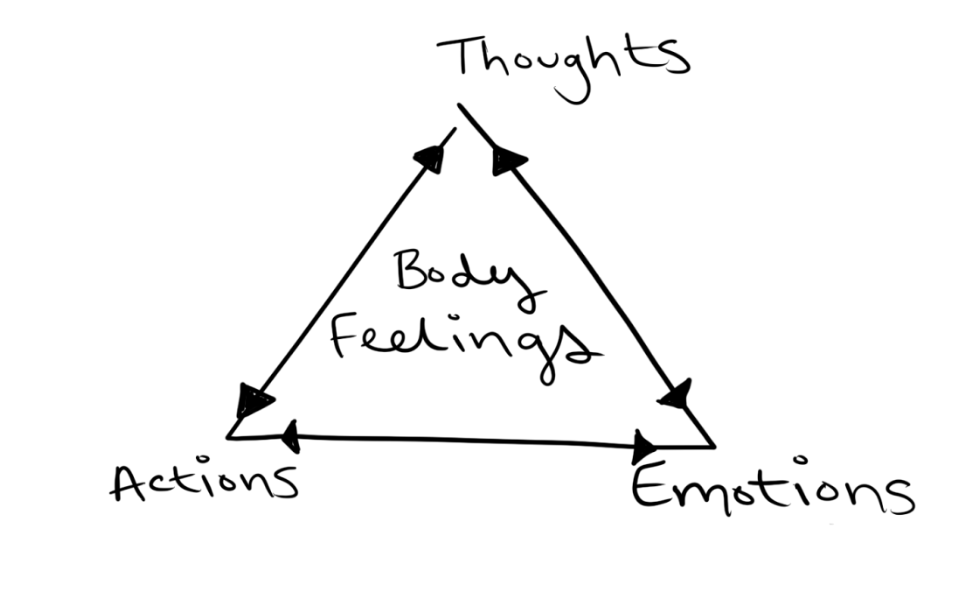
We are embodied people. When I start counseling with people, this is often where I will begin. We are people who make sense of our lives and experiences through story-telling, in which our external and internal experiences are filtered through an amalgamation of our thoughts, our emotions, our actions, and our body feelings. We create meaning about our lives and our stories using these as filters. But what if these things weren’t reliable? Then what?

I typically start with these four, drawn in a triangle as below: 

So, the arrows indicate the interrelatedness of the parts. How you think affects what you do and how you feel, how you feel affects what you’re thinking about and what you do, etc. You get it. And in the middle of all of this is how your body feels. Are you feeling tired? Hungry? Energetic? Cold, nauseated, sick? These are all body feelings. But why start with these?

Let me ask you: What would be easiest to change if you wanted to? The answer I hear most often is actions, though other answers aren’t uncommon. On the flip side, what would be most difficult to change if you wanted to? I hear thoughts and emotions most often for this answer. 

Our Emotions

As far as emotions go, they come and go. They aren’t always informed by facts. You can become very upset over what turned out to be a small understanding that snowballed into the makings of a sitcom episode. You can have a panic attack when there is no identifiable danger. You can feel depressed when there is nothing particularly sad happening in your life. Emotions aren’t always dependable signals off of which to base decision making- you can have a lot of anxiety about enrolling in college, or starting a new job. It could still be the wisest course of action for you, despite having anxiety. Emotions are a signal to us, but we aren’t meant to “follow [our hearts]”. In fact, the Bible tells us plainly that “the heart is deceitful above all things and desperately wicked. Who can understand it?” 

God understands our hearts and He knows our frame. He isn’t intimidated or thrown off by our emotional experiences. In fact, He has great compassion for what is going on inside our hearts. He doesn’t command us to “stop crying and get your act together”. No, instead He encourages us to “cast our anxieties on Him, because He cares for us”. Emotions are a powerful thing, and sometimes they can feel completely paralyzing or overwhelming to us. But God is ready, able, and wanting to be our firm anchor in the midst of the storms of our life that blow our emotions to and fro. 

“Therefore, having put away falsehood, let each one of you speak the truth with his neighbor, for we are members one of another. Be angry and do not sin; do not let the sun go down on your anger,  and give no opportunity to the devil.”

Ephesians 4:25-27

However, sometimes our emotions are a helpful signal that tip us off that something is wrong, or something is right. The Bible is clear that there are occasions that it is appropriate to be angry. Paul tells us in Ephesians to “be angry and do not sin; do not let the sun go down on your anger, and give no opportunity to the devil”. I know for me, when I finally understood anger wasn’t purely sinful, it felt so foreign. My own, childlike self had grown up categorizing emotions into “good” and “bad”. I think most people grow up with this kind of basic understanding of emotions. Because honestly, “good” and “bad” really could be also stated as “comfortable” and “uncomfortable”. 

Comfortable EmotionsUncomfortable Emotions
HappinessSadness
SurpriseShock
ContentmentFear
LoveAnger
CompassionEmbarrassment
PrideLoneliness
ExcitementShame
RelaxedDisgust

Friends, we all experience this wide range of emotions. When we have the Holy Spirit lives inside of us, we are empowered to choose righteousness, in spite of what uncomfortable emotions we are feeling on the inside. Check out my post tomorrow as we explore anger.

See you then, friends,

Rachel 

Safeguarding Teens: Combatting Sexual Abuse

Explore my comprehensive guidebook dedicated to safeguarding teens against sexual abuse and grooming tactics!

Do you want to equip your teens to recognize abuse and predatory behavior before it begins? More Flashlights is the book for you. Laid out for easy reading with engaging graphics, More Flashlights is a concise book designed to give teenagers and the adults in their lives the tools they need to recognize the warning signs of abuse, and know how to deal with it.

This short, digestible book is designed to be easily read and understood by a wide range of ages. With captivating illustrations, “More Flashlights” empowers your teen to navigate challenges effectively, make informed decisions, and establish resilient boundaries for a healthier future. More Flashlights is for sale out on Amazon, and you can check out more info at moreflashlights.com.

Finding Hope Through Faith-Based Counseling

Hey there, friends,

Why do I involve faith in my counseling?

While traditional counseling can get you a great deal of relief from symptoms, I have always found that I hit a ceiling when God is not part of the picture. He is the One who made us and the Great Physician; connection with Him is the biggest agent for change that you can possibly have! As we walk through the research-backed treatment methods that the counseling field has found effective, we will also turn to the God who designed the world and the people who live here. When we live in God’s world, God’s way; we find flourishing and fullness of life. But how do we connect with God?

God is the One who made us, and He made us for relationship with Him. He wants to talk with us! But our sins caused a disconnection between us and God. God is perfect and just. Because of this, He cannot tolerate sins or wrongdoings. Lying, stealing, cheating, wishing ill upon others or feeling jealous of others’ lives or things- these are all sins. We are stuck in our sin, and we don’t have the solution to it. The Bible tells us that “all have sinned and fallen short of the glory of God” (Romans 3:23). Unfortunately, “the wages of sin is death” (Romans 6:23), and we can’t repay that debt ourselves. If we could have fixed this problem, surely we would have found the solution by now…however many thousands of years of human civilization have only continued to replay the same old patterns of pettiness, injustice, anger, etc. that are in the hearts of all humans. And God knew that we didn’t have the resources to solve this problem ourselves.

“But God didn’t, and doesn’t, wait for us to get ready. He presented Himself for this sacrificial death when we were far too weak and rebellious to do anything to get ourselves ready. And even if we hadn’t been so weak, we wouldn’t have known what to do anyway. We can understand someone dying for a person worth dying for, and we can understand how someone good and noble could inspire us to selfless sacrifice. But God put his love on the line for us by offering his Son in sacrificial death while we were of no use whatever to him” (Romans 5:6-8). “God so loved (all people, including you) that He gave His only Son, that whoever believes in Him will not perish, but have everlasting life”. (John 3:16). Jesus, the perfect son of God, lived a life as a man, but without sin. He then died in our place, paying the penalty for our sins that we couldn’t repay. God then raised him from the dead three days later, in victory over death itself. “If you say with your mouth that Jesus is Lord, and have faith in your heart that God has made him come back from the dead, you will have salvation”. This was God’s plan to provide a means of reconnection and relationship with us again. “His purpose [in making the world ] was for [people] to seek after God and perhaps feel their way toward him and find him—though he is not far from any one of us. For in him we live and move and exist.” (Acts 17:27-28.) He wants us to be direct with Him and ask Him for what we need- “Ask and it will be given to you; seek and you will find; knock and the door will be opened to you.”  His free gift of connection stands. He loves you massively, and is overjoyed to live in connection and relationship with you, if that is what you want. 

He loves us, friends,

Rachel

Understanding Stress: Causes and Solutions

“Just relax!” How many times have you heard that one? And just how helpful was it? Probably just made you feel more stressed! So what can you do?

How stress affects us

Stress has such a holistic approach to our bodies. And not in a good way. It can affect us emotionally, physically, and mentally. We can get to where we feel fatigued on a regular basis, develop ulcers, have constant headaches, or become sick more often. Stress can cause us to develop “scatter brain”, having a difficult time remembering or keeping track of tasks. It can keep us from sleeping with racing thoughts, or induce much more sleep than usual with depression. It certainly can cause us to more easily lose our temper, feel sad, feel hopeless, or wish for an escape of some kind. And those emotions can and often do lead to some sort of coping mechanism to address them. I’ve heard of a whole range of coping mechanisms: exercise, alcohol, excessive shopping, cell phones, video games, cooking, marijuana, talking with a friend, sex, listening to music, reading, food, self-harm, journaling, crying, exploding at others, or a host of other responses.

How to address stress?

Some of these coping mechanisms are going to be more or less desirable/helpful than others. The goal of stress reduction is to figure out how to either reduce the source of stress that has been steeping its flavor into our lives, or to discover how to increase our capacity to respond in healthy ways to that stress. Using unhealthy coping mechanisms, while they feel helpful in the moment, only serve to increase your stress over the long term. Which sucks big time.

Decreasing stress externally

One of the ways to address and manage stress in your life is to evaluate things in your environment which could be changed. Could household chores be divided differently? Could you afford to clean less or take shortcuts for your peace of mind? What is your job like? Are you in a toxic environment at work? Is there a support system of people who you could tap into to help you, or do you need to evaluate the long-term effects of keeping that job on your mental health and sanity? Are you burnt out from caretaking and need some more support? Getting some sunshine and a bit of exercise every day has been proven to boost mood, as has getting proper nutrition and hydration levels. Is your life at a place that you can even spend the time on this kind of self-care? Managing your environment, allowing progress instead of perfection, setting boundaries with others, and/or reaching out for support from others may provide some viable means to reduce your stress levels.

Decreasing stress internally

What does the inside of your head sound like to you? Are you your own worst critic, berating yourself for supposed stupid mistakes or things you said? Where is your kindness towards yourself? Maybe you find yourself worrying, and worrying, and worrying until your thoughts are a frantic freight train racing through your mind, day and night. I use this question for my clients who struggle here: If a friend was telling you about the exact problem you are telling me, would you scold them for thinking/feeling such things? Much of the time, the answer is “no, I would reassure them that this is only temporary, that they will do better next time”. And yet, people often have a strong argument for why they don’t deserve this same kindness towards themselves. Please, argue against these thoughts! Use logic to fight against these intrusive thoughts! And remember to be kind to yourself. Give yourself a break for mistakes or awkward moments. You are only human. Your thoughts and beliefs about yourself can be a huge source of stress, or a big source of inner resiliency.

Additionally, you may have neurochemical or physical stressors that need to be addressed medically before you find that you are able to make traction in the mental health department. Struggling with panic attacks everyday, suffering from chronic pain, have inflammation and allergies to food or pollen- these are just a few things that you might talk to your doctor about and see what your options are. We are embodied people; the state of our bodies very much affects our mental health.

Increasing your connection with others, and your connection with God, is a huge resource. We aren’t made to be an island unto ourselves; connection with others is a hardwired need in our brains. The top reason that infants in orphanages fail to thrive, (failing to develop, lose weight, don’t smile or talk), is a lack of love, touch, and nurturing. That’s a lack of connection! And this need for connection doesn’t go away as we get older. Tapping into your supports, those people in your life who are encouraging, engaging, and there for you, can make a big positive impact on your perceived levels of stress.

The same, and more, can certainly be said about the Lord as well. He is the One who made us, and He made us for relationship with Him. He wants to talk with us! “His purpose [in making the world ] was for [people] to seek after God and perhaps feel their way toward him and find him—though he is not far from any one of us. 28 For in him we live and move and exist.” (Acts 17:27-28.) He wants us to be direct with Him and ask Him for what we need- “Ask and it will be given to you; seek and you will find; knock and the door will be opened to you.” His free gift of salvation and connection with Him stands. If anyone confesses with their mouth that Jesus is Lord, and believes in their heart that God raised Him from the dead, they will be saved. God loves you massively, and is overjoyed to live in connection and relationship with you, if that is what you want. He will support and sustain you through the ups and downs of this life, and His heart is for the weak and the downtrodden.

Additional Resources

Here’s a list of books, apps, and other resources that may be helpful tools as you try different ways to healthfully manage your stress:

Books

The Mindful Brain by Daniel J. Siegel

Mindfulness: An Eight-Week Plan for Finding Peace in a Frantic World by Mark Williams, Danny Penman, & Jon Kabat-Zinn 

Mindsight: The New Science of Personal Transformation by Daniel J. Siegel

Hardwiring Happiness: The New Brain Science of Contentment, Calm, and Confidence by Rick Hanson

Videos

TED Talk: How to Make Stress Your Friend: https://youtu.be/RcGyVTAoXEU

TED Talk: Generation Stress: From Surviving to Thriving: https://youtu.be/7jRND5IU3Qg

CALM: https://www.youtube.com/watch?v=JK-dmKLFGnw

Overcoming Bad Inner Voices: https://www.youtube.com/watch?v=gGuZVuUBeiQ

Self Compassion: https://www.youtube.com/watch?v=-kfUE41-JFw

Apps

  • Tapping Solution (Free content, also has a paid subscription with more)
    • Reduce your stress & anxiety by 41% with EFT tapping.
    • Lower your stress levels, reduce anxiety, overcome fears, relieve pain, get better sleep, and so much more. All made possible with access to hundreds of meditations in the Tapping Solution App. You’ll learn how to use Tapping (also known as EFT, or Emotional Freedom Techniques), to lead a happier and healthier life.
    • Over 10 million sessions completed so far, ranging in length from 5 minutes (a quick session) to 20 minutes (to guide your deeper work). 
  • Virtual Hope Box (Free)
    • “The Virtual Hope Box contains simple tools to help patients with coping, relaxation, distraction, and positive thinking. Patients and providers can work together to personalize the VHB content on the patient’s own smartphone according to the patient’s specific needs.”
  • Rootd (Free)
    • “Rootd is anxiety & panic attack relief any time or place you need it. With over 2 million users worldwide, Rootd is the go-to app for anxiety & panic attacks for more and more people each day.”
  • Breathe: relax & focus (free)
    • “Breathe is your ultimate tool for mindfulness and relaxation, offering a diverse range of breathing exercises tailored to your needs. It has 3 default breathing exercises and allows you to create your own custom breathing patterns:
      • Equal Breathing: helps you to relax, focus, and be present.
      • Box Breathing: also known as four-square breathing, is a simple and highly effective technique for stress relief.
      • 4-7-8 Breathing: also called “The Relaxing Breath” promotes better sleep. The exercise is described as a natural tranquilizer for the nervous system that eases the body into a state of calmness.
      • Custom Pattern: create unlimited breathing patterns with half a second adjustment.”
  • Insight Timer (Lots of free content, also a premium tier)
    • “FREE FEATURES:
      • 100,000+ guided meditations
      • Select by time for short meditations when on the go, helping you to build a simple daily habit
      • Thousands of music tracks and ambient sounds to calm the mind, focus, sleep better and relax
      • Customizable Meditation Timer
      • Thousands of discussion groups
      • Stats and milestones for tracking your progress”
  • Buddify- Mindfulness to Go ($3.99, extended features with membership)
    • “Over 200 meditations to help overcome life’s challenges including anxiety, stress, sleep, pain and difficult emotions
    • Mindfulness exercises you can do wherever you are, in categories such as travelling, at work, waking up, eating, and even when you’re online
    • Sessions for complete beginners and those with more experience, with lengths from 3-40 minutes
    • Kids content for the little people in your life
    • Brand new Buddhify Membership, available as an optional in-app purchase with a range of additional features for those looking to take their practice further”
  • Calm- Meditate, Sleep, Relax (Subscription-Based, Billed Annually $70)
    • “50,000+ Minutes of audio designed to relieve anxiety, stress and more
    • Soothing Sleep Stories narrated by familiar voices
    • Exclusive music for sleep and relaxation
    • Life-changing Calm Master classes taught by world-renowned experts”

Headspace (Subscription-based, Billed Annually $70)

  • “Welcome to Headspace, your lifelong guide to mental health, mindfulness, and meditation. Stress less, sleep deeper, and feel happier with expert-guided meditations, one-on-one mental health coaching and daily mindfulness exercises. Choose from hundreds of meditation sessions on how to meditate properly, sleep better, manage stress, learn breathing techniques for everyday anxiety, relax, achieve calmness and improve mental wellness.”

Not every way of dealing with stress works for everybody; you may need to try quite a few different things before striking upon something that works well for you. Working with a counselor can also help to clarify and sharpen your goals and skills in stress management. What has worked well for you in the past to really calm down and cope with stressful situations? Let me know,

You’re not alone, friends,

Rachel

Top Green Flags for Finding the Right Therapist

Hello there, friends,

It’s such a hard journey to find the right therapist for counseling; whether you’re looking for individual counseling, couples’ therapy, or family therapy. It can take a while to find the therapist who’s “just right”. Here are a few green flags to be on the lookout for:

  • A good therapist will create a space where you feel seen and heard. You should mesh well with your therapist and feel comfortable with them as a person. This person will leave plenty of room for you to talk about what’s on your mind. They will minimally talk about themselves or their own life experience, because therapy is about you. (And actually, our ethics govern our self-disclosure to patients. We ethically self-disclose only when it doesn’t harm you, actively benefits you by sharing, and keeps your interests and well-being as the top priority in the therapeutic relationship.)
  • A skilled therapist will be equipped to address your specific needs, whether that’s for a place to vent, assigning homework, and/or challenging you where you need it for growth. Along with this, a skilled therapist will only take you on as a client if they have the full set of tools needed to help your specific situation. They should be open about their training, specializations, and how that pertains to their work with you. I typically share this information on all my therapist profiles online, as well as during our initial consultation call.
  • If you are feeling uncomfortable with the speed or the focus of therapy, a good therapist should be responsive to your input and make changes in how they are structuring your therapy sessions. Therapy is about you. You have paid them for their expertise, and therapy should be helpful for you. Ideally, your therapist should have a humble, partner-with-you approach. They will be responsive to your needs to either go faster or slower, and they will regularly check in with how you are feeling with the process of therapy, making adjustments as needed. I tend to check in with clients by asking them how they are feeling in their bodies (calm, tight, antsy, low-energy, serene) and use that to inform how I guide our sessions.
  • A good therapist will be clear in goal setting with you. Setting goals with achievable and measurable steps is the expected practice in mental health treatment. You don’t start on a project without a plan, budget, or timeline. Same goes for therapy. Therapy is meant to move you towards your goals, and there should be a clear plan on how that is accomplished. I typically do this on the second session, and will revisit goals at regular intervals and revise them if needed.

There are all kinds of personalities in therapists, whether you are looking for a gentle soul, more of a coach, a cut-and-dry therapist, a personable therapist who burps during your session and jokes around, etc., etc. Therapists are as varied as people are! What’s important is that you find someone who is a good fit for you. Hope these green flags are helpful, and if you’d like to talk about possibly exploring therapy with me, feel free to reach out!

Take care friends,

Rachel